Zhiyi Yang’s Poetry, History, Memory: Wang Jingwei and China in Dark Times (“the Book”) is a biased portrayal of a controversial historical figure, packaged in sometimes artful, but frequently obtuse, language. This response, however, focuses on the Book’s biggest problems—distortion of facts, mischaracterizations and selective use of source material.
The Book was published by the University of Michigan Press in November 2023, with a free Kindle download, while the Chinese edition was released in July, 2024 by Linking Publishing Co., Ltd. in Taiwan. The Book is promoted by the publishers as “the first biography of Wang that addresses his political, literary, and personal life in a critical light and with sympathetic impartiality.”
The mission of the Wang Jingwei Irrevocable Trust is to provide scholars, students and the general public with a comprehensive easily accessible archive of material that spans Wang Jingwei’s entire adult life, to provide the truest and most fitting biography of this often-misunderstood historical figure. A biography by a credentialed author should not be ignored; we also believe the Book may have an impact beyond academia, particularly among non-Chinese readers who might have heard the name Wang Jingwei and are curious to know more. Six concerns with Poetry, History, Memory are highlighted here:
The fact that Professor Yang chooses to write this book is, in itself, remarkable. She has given the project much thought, which should be encouraging. However, her book is a disappointment.CINDY HO, Wang Jingwei’s granddaughter and Managing Editor of Wang Jingwei and Modern China
We follow a simple method. Whenever we find a noteworthy assertion in the Book that is contrary to our own findings, we consult source material cited by the author and, when necessary, we review other primary source materials to confirm essential facts, most of which have been published. We also attempt to resolve confusions and point out contradictions found in the author’s text with particular focus on information directly involving Wang Jingwei and his family and Wang’s own published words.
This response is based on the Kindle English language edition and is independent from our response to the Chinese publication, since the tone and amount of detail in the two editions differ significantly. This fact is worthy of note, because non-Chinese readers are not able to independently review the author’s problematic use of original source material, which is mostly available only in Chinese. We cite notable examples in this response.
We hope the author and her audience will read and reflect upon this presentation with the seriousness of spirit and purpose for which it was intended. The author is free to share her theories about poetry, her interpretations of individual poems, the concept of memory, and criticisms of Wang Jingwei. But she is not free to ignore historical facts or misconstrue Wang’s words and actions in ways that contradict primary source material. The author works hard to justify her biased portrayal with a premise for her Book, which we show to be false. She employs selective use and misuse of source material to the frequent exclusion of her subject’s own words. She even goes so far as to assert knowledge about her subject’s psychological state, private thoughts and intentions superior to Wang himself.
In this response, we provide content and context to assist readers and researchers in a manner consistent with the stated goal of the Trust’s cofounder Ho Mang Hang: to encourage researchers and writers of modern Chinese history to consult primary source material whenever possible to gain fresh insight. Historical actors deserve as much, and truth in history demands nothing less.
This “biography” uses and misuses primary source material to create a false narrative in yet another attempt to wipe Wang Jingwei’s political thought from memory.CINDY HO
The Book begins with a dumbfounding claim in the “Introduction” that serves as a recurring theme:
Perhaps in anticipation of posthumous damnation, Wang Jingwei on his deathbed asked his family and followers not to publish his speeches or essays.
and ends in the “Epilogue” with:
Wang Jingwei’s last wish to be remembered solely through his poetry,…

Cloud, Smoke, Scattered Memories—the Memoir of Ho Mang Hang
Cloud, Smoke, Scattered Memories — the Memoir of Ho Mang Hang is cited as a primary source. But Ho’s account of Wang’s last wishes on his deathbed (found here and recounted in detail in his memoir) says something quite different:
On a visit to Wang Jingwei at his hospital bed, Minister of Publicity Lin Baisheng tactfully asked whether Wang had any additional instructions to leave behind. Wang Jingwei answered to the effect that: While my life’s thoughts and speeches had gradually been published according to changing times for everyone to see, what can truly be handed down to future generations is Shuangzhaolou shici (Wang Jingwei’s poetry collection.)
Yang’s Book gives Ho’s words a different meaning:
Lin Baisheng’s visit must have happened in the fall, on which he finally broke the delicate taboo and asked: “Do you have anything you entrust us to do, sir?” Wang was silent for a long while before he answered: “All the thoughts and speeches of my life, following the changing times and tides, have been published, which are for everyone to read. The only writings worth preserving for later generations are the Double-Shining Tower collections of poems.”
The phrases “must have happened in the fall” and “finally broke the delicate taboo” are not found in the source text. Even more alarming, “what can truly be handed down for future generations” in the Ho memoir is changed to “The only writings worth preserving for later generations.” This is a distortion of the only first-hand published account of Lin Baisheng’s final meeting with Wang Jingwei.
Another example of this practice appears immediately after the misrepresentation of the Ho Mang Hang memoir. A passage from the book by Fuyuko Kamisaka (1930-2009), I Walk the Path of Hardship: The Truth About Wang Jingwei (我は苦難の道を行く : 汪兆銘の真実) (Tokyo, Bungei Shunju, 2002, volume 2, page 110) is paraphrased. Rather than quote Kamisaka directly, the Book gives the Kamisaka passage a different meaning than the source text:
This wish is corroborated by the eldest son Wenying’s recollection: in their last meeting in early November, Wang explained to him that his treatises and speeches were only responding to the concrete needs of the times and should be consigned to oblivion…
But the passage in the Kamisaka book actually reads:
自分はこれまで沢山の論文を書き、その時々に行った演説も論述として残されているが、こんなものにさして意味はない。というのは論文も演説も、時流の中で臨機応変に説いたものであり、いずれは色あせていくからだ。中には人々の喝采をあびた論述もあるが、どれもこれも時がたてば忘れられるだろう。
私の心情を確実に伝えるものは詩だけである。
(I have written many essays and speeches that I have given at various times, but they are not very meaningful. This is because essays and speeches are written to adapt to the changing times and will eventually fade. Some of my writings have been met with great acclaim, but they will all likely be forgotten in time.
Poetry is the only thing that can reliably convey my emotions.)
Without consulting the Kamisaka book, readers will not be aware that phrases such as “should be consigned to oblivion” are not Kamisaka’s words and certainly not Wang Wenying’s words. Using the Kamisaka book as a source is in itself problematic, because Kamisaka does not quote Wang Wenying directly. She paraphrases, using her own words, not quoting Wang Wenying’s words.
Paraphrasing, subtracting and augmenting rather than quoting directly from a source may cause readers to conclude that evidence exists when no such evidence is present in the quoted source. This practice puts non-Chinese readers at a particular disadvantage, since they have no ability to review the Chinese sources independently for verification.
Other examples of this problematic use of source material throughout the Book can be found here.
—
There is no record that indicates Wang Jingwei worried about his reputation or asked that his writings be forgotten. Instead, Wang made frequent references to his own published works and wanted to be remembered through his words. Throughout his political career, Wang made it clear that “anticipation of posthumous damnation” (Yang’s words) or merely keeping a good name was never a consideration. From the 1910 attempted assassination of the Prince Regent to the establishment of the Reorganized National Government (RNG) in 1940, Wang Jingwei was keenly aware of his critics and the risks of danger to himself. Yet he consistently showed in word and in deed that he did not retreat from potential danger. The allegation that Wang Jingwei wished to consign his own political thought to oblivion appears to justify the PRC ban on the publication of Wang Jingwei’s writings.
The literary scholar Long Yusheng (1902-1966) remarked on Wang Jingwei’s unique and unwavering ability to disregard praise or criticism, gain or loss in his transcription of Wang’s 1910 essay “Determination for Revolution,” created in 1947 while Long was in prison. (See Prison Writings by Members of the Wang Jingwei Regime II, pp. 2-6) We also see evidence of Wang’s unwavering convictions in his own words:
- Wang’s letters to Hu Hanmin in 1909 (May 8 and December 27) and Sun Yatsen in 1910 (January 11) speak of his resolve to carry on the revolutionary mission even in the face of adversity. (Wang Jingwei’ Political Discourse Vol. I, pages 39, 44, 49)
- In his 1934 “Autobiographical Draft” Wang does not say he should be remembered only by his poetry. Instead, he says:
My essays and speeches are the truest form of my life story. There is no need for any other autobiography. (Wang Jingwei: His Life, Ideas & Beliefs, page 518)
This important statement does not appear in Yang’s “biography.”
- Prior to his departure from Chongqing to Hanoi in December 1938, Wang offered members of his household the opportunity to leave his side in the face of impending danger and damnation. None did. Despite his nephew Wang Qi’s persuasion to reconsider the move because doing so might be risky, Wang departed for Hanoi on December 19, 1938. He did not fear danger or damnation. (Cloud, Smoke, Scattered Memories—the Memoir of Ho Mang Hang, pages 170-171)
- On March 20, 1939, assassins broke into his home in Hanoi and mistakenly took the life of Wang’s close associate, student and secretary Zeng Zhongming (1896-1939) instead of Wang, the actual target. In a brief letter to Zeng’s widow Fang Junbi (1898–1986) five days later, Wang wrote:
No matter how devastated I feel, the steps to save the country cannot be disrupted, do not worry.
This sentence underscores Wang's determination to stay the course and not retreat out of fear. (Wang Jingwei: His Life, Ideas & Beliefs, page 413)

Wang Jingwei’s Political Discourse: Selected Essays, Speeches, Letters and Telegrams
- On March 27, 1939, one week after Zeng Zhongming was killed in Hanoi, Wang wrote in the essay “One Example” (Wang Jingwei’ Political Discourse, pages 431-446):
Should I die, I hope my compatriots will re-read these lines and clearly understand that my policy is the road that will lead China to her salvation, and secure permanent peace in the Orient and in the world generally. Though my suggestions may not be acceptable to Chungking to-day, the time will certainly come when there entire Chinese nation as well as the people of Japan will welcome my Proposals, and I shall have no regrets. (Translation by T’ang Leang-li)
In other words, Wang called for his words to be read and re-read after his death, not “consigned to oblivion.” The author fails to mention this part of the essay in her otherwise detailed summary of “One Example” likely because it directly contradicts the Book’s assertion that Wang engaged in self-censorship fearing “posthumous damnation.”
- In “Response to an Overseas Chinese” (30 March 1939) Wang Jingwei writes (Wang Jingwei’ Political Discourse, pages 447-452):
Everyone know[s] that ever since I became an active revolutionary some thirty years ago, I have never thought of own self or my personal welfare. Why should I start thinking of my own own selfish interests now that I am over fifty years, when I see the country… on the verge of extinction? (Translation by T’ang Leang-li)
- The essay that the Book refers to as “My Final Sentiments,”which is considered to be Wang Jingwei’s last will contains no mention of fear of damnation, regret or any wish that his political writings be “consigned to oblivion” after his death. (Wang Jingwei’s Political Discourse, pages 670-679.)
- In the 1988 published recollections of Ota Mototsugu, which the Book cites as a source, Wang Jingwei’s last words on November 10, 1944 were:
I must go back to China.
There is no mention of fear of damnation, regret, or any wish to have his political discourse silenced.
- The Book also does not mention the efforts his family and associates did make to preserve and publish Wang’s poetry, essays and speeches which began soon after his death and continue to this day.
- In the preface for Wang Jingwei: His Life, Ideas & Beliefs, Wang Jingwei studies expert Wang Ke-wen wrote:
Mr. Ho Mang Hang fulfilled Wang Jingwei’s last wish with true dedication, gathering Wang’s letters, speeches, essays and poems, including key works such as his testimonial written upon his arrest during the late Qing Dynasty. Ho weaves together a comprehensive biography of Wang, citing excerpts from his life. Beyond explaining the historical context and political situation, he offers almost no analysis or judgment, allowing Wang to speak for himself. Unlike most biographies of Wang, the book neither resorts to scathing criticism nor blindly eulogizes. Instead, it offers a refreshing and unpretentious account of Wang’s life, witnessing the turbulent China from the late Qing Dynasty to the war against Japan.
Rather than list every factual error in the Book, we highlight those that may have resulted from:
(a) disregarding, misreading or misinterpreting primary source material;
(b) accepting erroneous assumptions found in previously published works;
(c) assumptions based on incomplete evidence.
Here are some examples:
Air Raid On Nagoya Occurred After Wang Jingwei’s Death
Wang Wrote Eight Words In blood, Not 2,000 Words
Third Arresteee Was Not A Coconspirator
No Wang Family Members Grew Up In France
Air Raid On Nagoya Occurred After Wang Jingwei’s Death
The melodramatic first paragraph on page one of “Introduction” reads:
In the late afternoon of November 10, 1944, an emaciated Chinese man lay dying in the Nagoya University Hospital. Heavy Allied shelling of the city confined him to a cellar ward in the suburban campus. These metallic angels’ drumbeats forebode the downfall of the Empire of the Sun and his own trial by history on the charge of treason. He was Wang Zhaoming (1883-1944), better known by his sobriquet Jingwei, one of the most controversial figures in modern Chinese history.
But there was no “heavy allied shelling” or “metallic angels’ drumbeats,” because Allied air raids over Nagoya did not begin in 1944 until December 13, more than a month after Wang Jingwei had died and his body had been flown back to China for burial.
Wang Wrote Eight Words In Blood, Not 2,000 Words
The author’s discussion of the attempted assassination of the Prince Regent makes the following claim:
In a letter to Hu Hanmin written in his own blood, he [Wang Jingwei] declared that he had been obsessed with this idea for two years and would not change his mind.
She is referring to a 21-word declaration in a 2,000-word letter written by Wang to Hu Hanmin dated May 8, 1909, which says:
自丁未以來,蓄此念於胸中,以至今日,千迴萬轉,而終不移其決心
(Since 1907, I have had this thought in my chest turning around and around, but my determination is not wavered.) (See Wang Jingwei’ Political Discourse, Vol. I, pages 39-42.)
But Hu Hanmin noted in his memoir that Wang wrote another, much shorter, letter “containing only eight words, in his own blood” that says:
我今為薪,兄當為釜
(I am the firewood, you are the cauldron)
The author confuses the 2,000-word May 8, 1909 letter with another eight-worded letter written in blood. Her absurd claim that a 2,000-word letter was written in blood as an indication of Wang’s “obsession” is based on an incorrect reading of the source material. In any case, Wang’s May 8, 1910 letter to Hu Hanmin expresses determination, not obsession. Here, as she does many times in the book (examples shown here, here and here), the author paraphrases a quote in a way that misinterprets the original sentiment, showing evidence of bias, creating contradictions and confusions for her readers in a text that is riddled with errors.
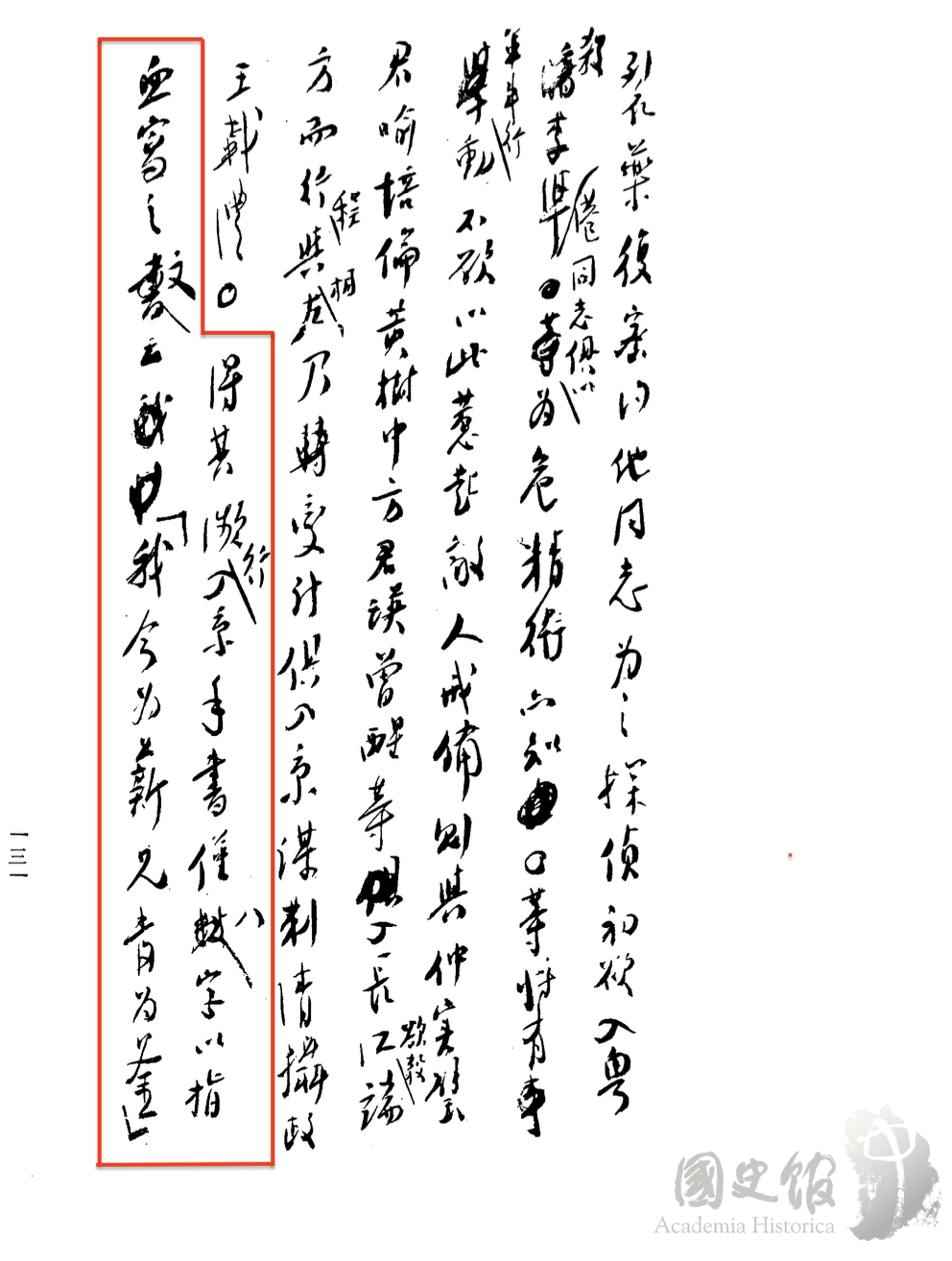
According to Hu Hanmin’s own account, Wang Jingwei wrote him a letter in blood with only 8 words.
Third Arrestee Was Not A Coconspirator
The Book claims that a third “coconspirator” was arrested along with Wang Jingwei and Huang Fusheng for the attempt on Prince Regent Zaifeng in 1910. But primary source material in Wang Jingwei: His Life, Ideas & Beliefs, which is cited as a source for this assertion, says something quite different:
-
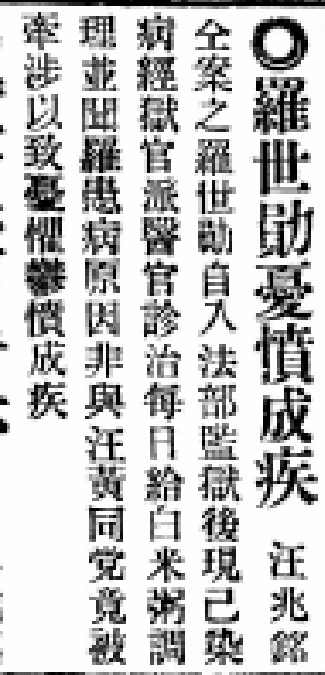
News report on Luo Shixun in Shuntian Shibao, May 4, 1910
Wang’s “Draft of an Autobiography” describes the third person arrested as “a servant who was completely uninvolved” on page 216. On page 220 he identifies the third person by name:
Even the clerk at Shouzhen Photography Studio named Luo Shixun was sentenced to 10 years in prison.
- In the same book, Wang identifies all the members of the assassination squad, Luo’s name is not on the list.
- In the photographs of the plotters, we see everyone Wang listed: Wang himself, Fang Junying, Zeng Xing, Chen Bijun, Li Zhongshi, Huang Fusheng, and Yu Peilun. Chen Bijun’s mother Wei Yuelang who helped finance the attempt was also prominently mentioned in Wang’s writings and photographed with the squad. But Luo does not appear in these photos.
In addition,
- A May 4 1910 newspaper announcement declares Luo’s innocence; having been unjustly accused and imprisoned was likely the cause of his illness.
As she does elsewhere in the Book, the author ignores primary source material, including Wang’s own written account.
No Wang Family Members Grew Up In France
The Book’s claim that “…multiple members in the extended Wang family grew up in France” as the reason why in 1939 the Wang Jingwei group went to the French colony Hanoi and thus “were able to communicate with the colonial government” is false. While it is true that Wang’s son Wenying (who was not present in Hanoi) and his eldest daughter Wenxing were born and spent a few years in France, none of Wang’s family members “grew up” in France. According to the memoir of Ho Mang Hang, only two people related to Wang who were in Hanoi at the time spoke French—his nephew Wang Qi and Zhu Mei, the daughter of another nephew Zhu Zhixin — but they did not grow up in France.
Conversation Misattributed To Wang Jingwei
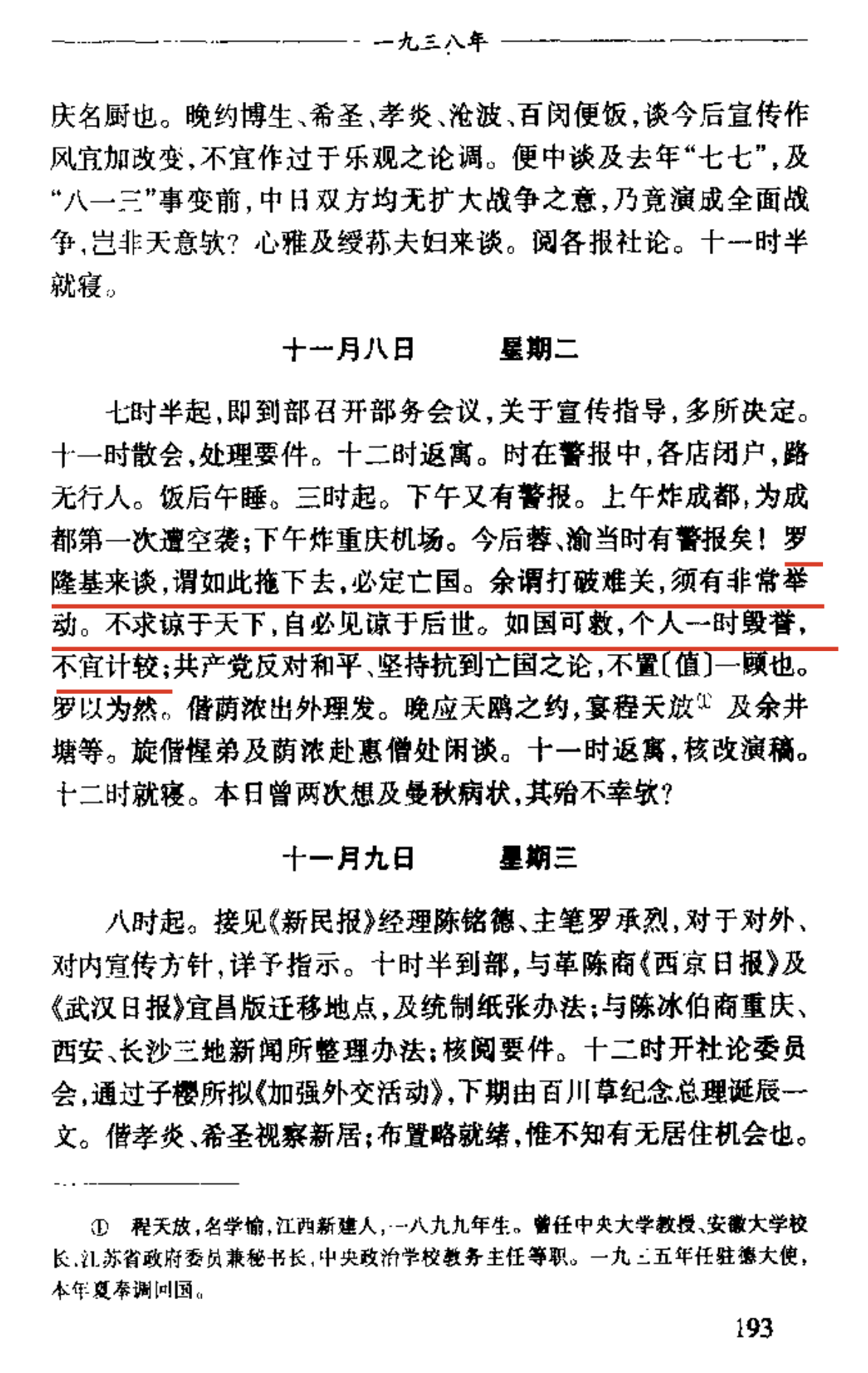
In a lengthy passage, the author describes Wang’s “yearning for action” and how he “must have felt useless” because “doing nothing was not how he envisioned his role in history,” citing a Zhou Fohai diary entry dated November 8, 1938 as her source:
It was Zhou Fohai who suggested to Wang that a brave man should sacrifice his reputation to affect the situation.
But after checking Zhou Fohai’s diary entry on that date (see below), we find that Zhou was actually recording a conversation with Luo Longji, not Wang Jingwei, whose name was not mentioned at all in the diary entry on that date.
Ho Mang Hang And Cai Dejin
The author claims that Ho Mang Hang “avidly assisted Cai Dejin.” But as we point out here, Ho wrote one letter in response to one letter he received from Cai. Ho’s response was critical of Cai’s biography of Wang Jingwei, which was published before the exchange of letters. There was no “assistance.”
Wrong Dates, Locations, Names And Citations
In the Book, the author makes a number of factual errors, some of which are listed below:
- Wang Jingwei’s brother Zhaohong died in 1903, according to the genealogical record compiled by their elder brother Wang Zhaorong. The reference to “Zhaohong 兆鋐 (1878–1904?)” is inaccurate.
- University records indicate Wang Jingwei studied at Hosei University 1904-1906, not 1905-1906, as shown in “Timeline of Events.”
- Cindy Ho was not born in 1957, far from it. No one contacted Ho for verification.
- The location of the house where the Hanoi shooting took place was named Rue de Colomb in 1939. It is now renamed Phan Bội Châu, not Rue Riz Marché(?).
- The author appears to suggest that all the “collaborators” were detained in Tilanqiao Prison in Shanghai; no other prison or detention center is mentioned in the entire Book. But Chen Gongbo was never in Tilanqiao. Neither were Zhou Fohai, Lin Baisheng, Chu Minyi, Long Yusheng, Ho Mang Hang, and many others.
-
The Book states “Wang was checked into the suburban campus of Nagoya University Hospital.” But Nagoya Imperial University Hospital was located in the city of Nagoya, not a “suburban campus.” This mistake may relate to the presence of the plum trees that Wang’s wife Chen Bijun donated to the hospital. In the late 1990s, Nagoya Imperial University Hospital was decommissioned (not bombed in 1944 as alleged in the “Introduction”). When the old hospital was taken down, the plum trees were temporarily moved to another building on the Nagoya University suburban campus and will be returned to their original location, according to University officials.
- Wang Jingwei’s eldest daughter Wang Wenxing died in New York City in 2015, not in New Jersey.
- The Book identifies Chen Bijun’s father as Chen Gengji 陳耕基. His name was actually Chen Gengquan 陳耕荃. The author perpetuates this often-repeated mistake.
- Ho Mang Hang’s name is misspelled in a footnote as “He Mengsheng.” His name in English was Ho Mang Hang, not the pinyinized “He Mengheng,” found in this Book, although some library catalogs and online databases do use this spelling. He used the name Ho Mang Hang or Ho Man Kit after moving to Hong Kong in 1948, not when he moved to the USA decades later, as the Book alleges in the Chinese edition, but not in the English language edition.
- “He Mengheng” is the listed editor of the series Wang Jingwei yu xian dai Zhongguo (Wang Jingwei & Modern China) and its six volumes, not “He Chongjia,” as the Book indicates. In fact, none of the six volumes in the series are correctly cited in the Book, making them difficult for the non-academic reader to locate in libraries or online databases using the author's inaccurate citation. The 2019 Wang Jingwei & Modern China series should be cited as they appear in Worldcat.org:
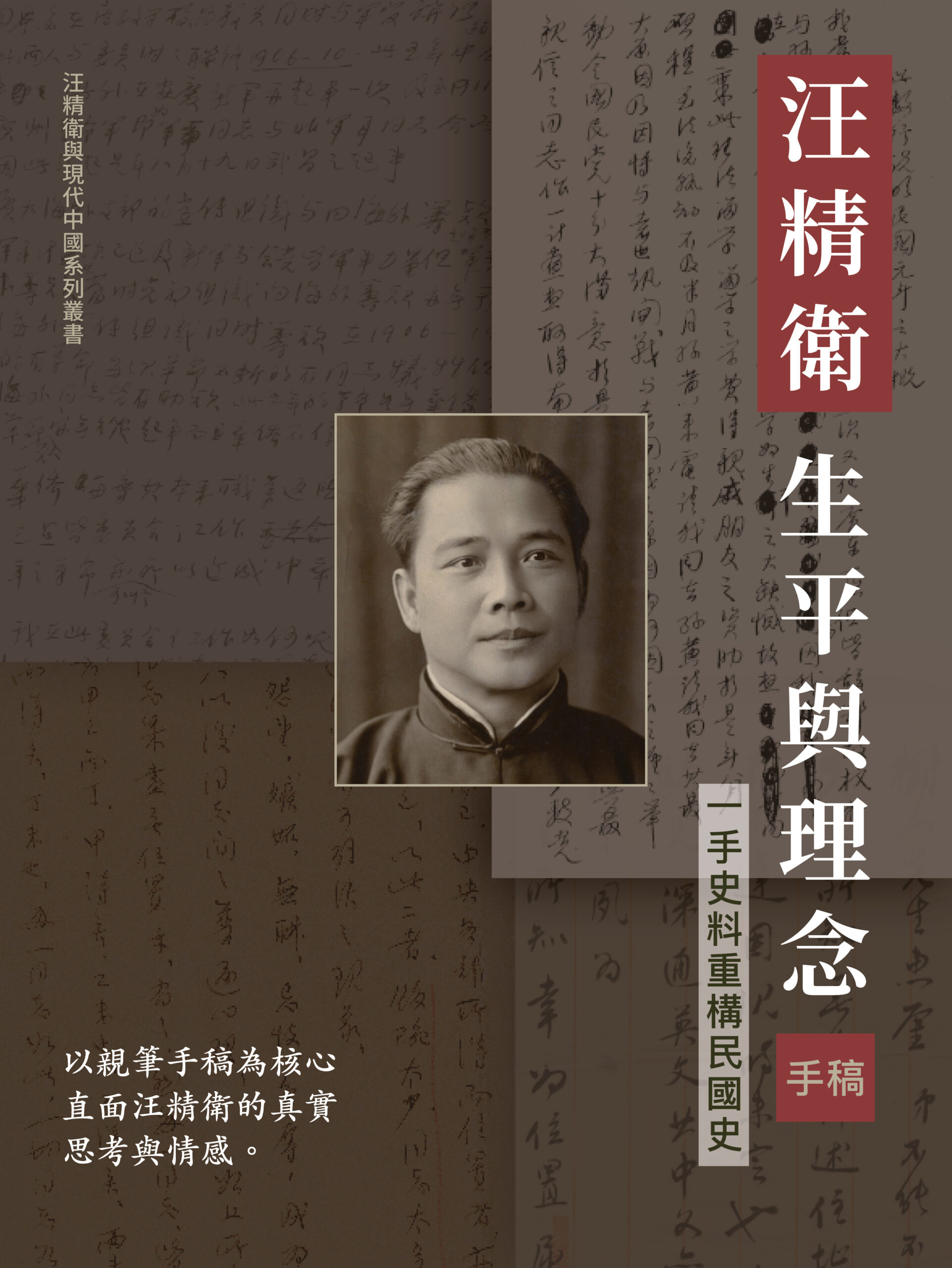
Wang Jingwei yu xian dai Zhongguo (series)
Wang Jingwei sheng ping yu li nian
Wang Jingwei zheng zhi lun shu xin bian
Shi kou hu qiao: Wang Jingwei xiang guan ren wu yu zhong xie zuo
He Mengheng yun yan san yi hui yi lu
- The managing editor of our books is Cindy Ho, not the pinyinized He Chongjia.
Wang’s Relationship with Chen Bijun
Wang Described as Having “Abandoned” Nanjing
Wang’s Relationship To Chen Bijun
Along with pop culture writers, the author seems invested in portraying the relationship between Wang Jingwei and Chen Bijun (1891-1959) as a one-sided pursuit with Chen as relentless suitor and Wang as reluctant complier. This is particularly obvious in the English version.
According to the author, Wang Jingwei “only considered her a friend and comrade,” and finally married Chen to “save her honor” in a “bizarre arrangement” because she was “following him in his steps.” To support her argument, the author refers to a 1910 letter in which Wang reveals his relationship with Chen to his close associates Zeng Xing (1882–1954) and Fang Junying (1884-1923), but omits a key section of the letter in which Wang declares love for Chen Bijun:
The two of us always consider love as what is important in life. Two persons could become friends if they love each other; two persons could become husband and wife if they love each other and get married…Therefore love will not be increased or reduced by marriage contract. My love for “Seventh Sister” [Chen Bijun] has remained the same throughout the years. (Read the letter in Wang Jingwei: His Life, Ideas & Beliefs, p. 355)
Wang continues in the same letter, that his earlier betrothal in an arranged marriage to someone he had never met was the reason for his initial hesitance to become involved in affairs of the heart and why he felt that he was unable to accept Chen’s love. The author must have read the entire letter. Yet she chooses to disregard Wang Jingwei’s emotions by selectively withholding his own words from her readers and mischaracterizes his relationship with Chen like a gossip columnist.
For a more scholarly view, we recommend this presentation and this extended remark by Hsu Yuming, Associate Professor of History at National Dong Hwa University in Taiwan.
Wang Described as “Abandoning” Nanjing

My Books, My Teacher— The Diary of Wang Wenxing
The Book describes Wang Jingwei and his RNG as:
…the collaborators who lost the city [Nanjing] to invaders and then came back to rule as Japanese puppets, their moral claim undermined by profound shame.
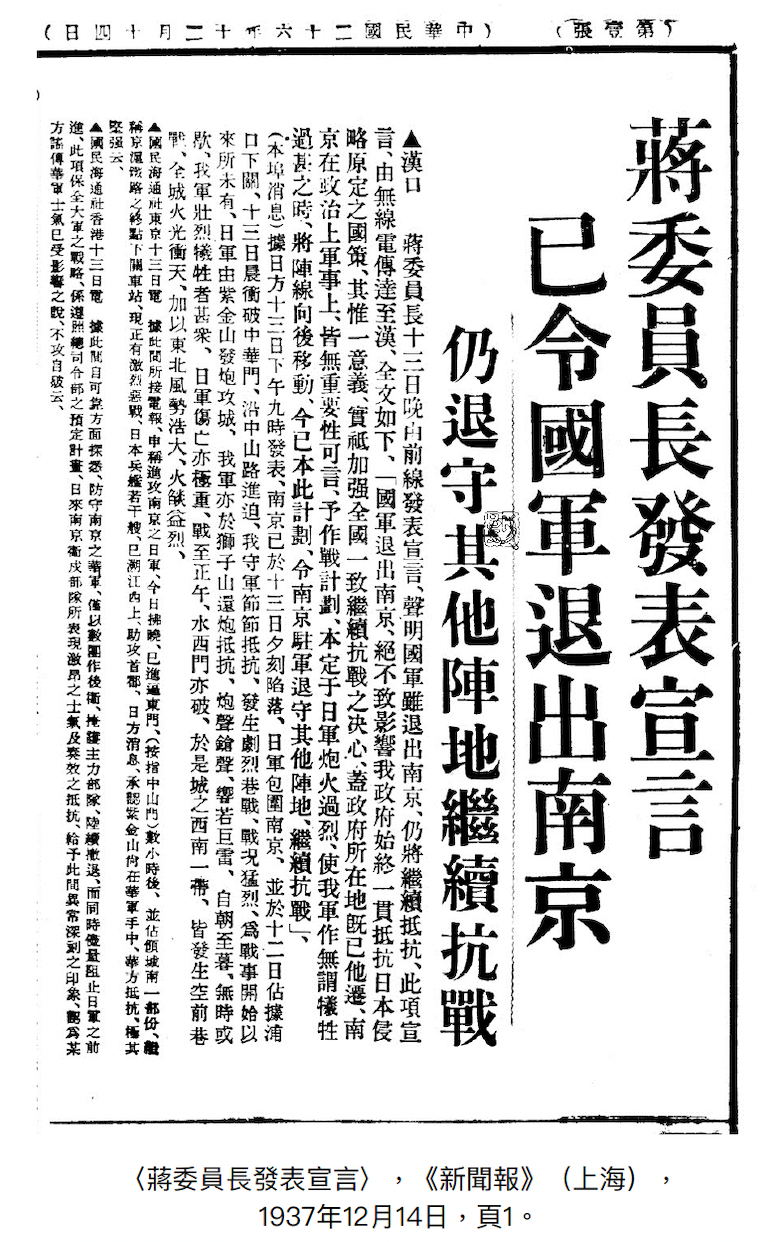
But who ruled Nanjing when the city fell in 1937? The answer is Chiang Kai-Shek, not Wang Jingwei. Nanjing was not Wang Jingwei’s to lose.
In the Chinese version, the Book attributes the abandonment of Nanjing to Wang and Chiang. But it was Chiang who served as the head of the Chinese government and commander-in-chief, who decided to move the capital from Nanjing to Chongqing, as a December 14, 1937 news report indicates in the photo below. Not Wang. Tang Shengzhi (1889–1970) was put in charge of the city’s defense by Chiang. The fall of Nanjing to the Japanese followed, on December 13, 1937. One year later, Wang Jingwei broke away from Chiang. His anger and sense of powerlessness over these decisions is well documented in his own words in Wang Jingwei Political Discourse and My Books, My Teacher: The Diary of Wang Wenxing.
Attempted Assassination Of Prince Regent Described As An “Obsession”
 To support the assertion that Wang Jingwei was “obsessed” with assassinating the Prince Regent Zaifeng, the author mistakenly quotes from a 2,000-word letter from Wang to Hu Hanmin, which the author falsely asserts was written by Wang “in his own blood”.
The Book’s repeated descriptions of Wang as an “assassin,” “erstwhile assassin,” “Wang’s past as an assassin,” “short career as an assassin,” also ignore the fact that Wang did not assassinate anyone.
The use of 刺客 (“assassin”) to describe Wang is equally rampant in the Chinese edition of the Book, which devotes a mountain of verbiage to the inflammatory label that culminates in a description of Wang Jingwei as “the Jing Ke of his time,” Jing Ke being a legendary would-be assassin who attempted to murder King Zheng during the late Warring States period in 227 BC.
Armchair Psychology
The Book describes Wang Jingwei’s actions as an internal psychological battle with his own “demons.” Repeated armchair diagnoses of Wang Jingwei — as suffering from “trauma, stress, and psychosomatic distress,” “a certain survivor’s guilt, as well as the tormenting thought that he might have been instrumental in causing” the deaths of his comrades; “inner demons”; “agonizing over unfulfilled commitments”; “distress and suffering” — eventually lapse into pop-psychology, not scholarly analysis.
The author also takes great lengths to portray Wang as making choices “not knowing if he is right or wrong, but with a presentiment of his failure and eternal disgrace,” as though impending doom lurked around every corner. Either the author does not fully understand the complexities of the situations at the time, or she purposely oversimplifies, boiling everything down to “success” or “failure” with nothing in between. Moreover her book fails to articulate what “success” and “winning” meant to ordinary people struggling to survive each day during the late 1930s and early 1940s, as millions continue to struggle in China today.
Presenting Wang as a calculating self-serving opportunist with nothing to stand on except for good looks, reputation (which he “wastes”) and a veneer of sincerity (which he “weaponizes”) who seized every opportunity to serve his own interest, the author even concocts a “transparent mask that Wang Jingwei wore to move about in the world.”
According to the author, the fact that Wang could write poetry with emotional power, at times filled with sorrow, proves that he needed to soothe his guilty conscience, using poetry as a shield against condemnation or “to transform the image of their regime, to interpret their present circumstances, and to imagine their fate.” In her view, his poetry suggests no other explanation, appearing to ignore her own caution elsewhere that conflating the poetic Wang with the actual person is a dubious reading strategy.
Does this conjecture relate to reality? Nowhere in the Book does the author demonstrate with evidence that Wang or his followers actually suffered from a guilty conscience. On the other hand, historian Hwang Dongyoun observes:
…none of the accused collaborators admitted that they had been “traitorous to the nation…”
The footnotes and bibliography cite an impressive number of sources. But, in some cases, footnotes are either misplaced or missing. Our findings, which focus on issues that relate to Wang Jingwei and his family, can be summarized as follows:
Selective Use of Scholarly Studies
Eyewitness Accounts Ignored or Discounted
Excluding Wang Jingwei’s Firsthand Accounts
Selective Use of Scholarly Studies
The number of serious academics who specialize in Wang Jingwei studies is relatively small, which makes the omission in this Wang Jingwei “biography” of the pioneering works of Wang Ke-wen and Han-sheng Lin, both prominent Wang Jingwei historians with extensive publications, all the more perplexing.
The absence of Wang Ke-wen’s work may be explained by his 2002 article, “Irreversible Verdict? Historical Assessments of Wang Jingwei in the People’s Republic and Taiwan,” which includes the following comment on the state of scholarship in the PRC and Taiwan:
Competing with each other for the credit of winning the war, neither party was interested in remembering the precariousness of the war effort, and thus the possible alternative of peace at the time. The Wang episode became an embarrassment in an otherwise glorious tale of heroism. Both parties were anxious to disassociate themselves from it.…
The “Wang studies” in the Mainland since the 1980s have been characterized by rich factual narratives but rigid and superficial analyses. All of the Wang biographies, for example, tell the same story of Wang’s life in basically the same perspective.
There is little in Yang’s Book that differs from previous Chinese narratives, which Wang Ke-wen described more than two decades ago in “Irreversible Verdict?” as follows:
Wang was invariably treated as a “negative figure” (fanmian renwu), and his career a “negative lesson” (fanmian jiaocai) in history.
Ho Mang Hang’s response to a letter from Cai Dejin expresses the same concern.
Omitting all reference to Wang Ke-wen’s works and any mention of his name allows the author to distance herself from the criticism contained in Wang Ke-Wen’s analysis, which she may find too uncomfortable. She also fails to mention Han-sheng Lin’s “Wang Ching-wei’s Memorandum to the Japanese Government, 1942” the significance of which Lin summarizes below:
This document indicates very well how the Chinese “collaborators,” particularly Wang Ching-wei and his followers, operated for the benefit of the Chinese in the occupied area…one of the most important documents uncovered so far relating to the operation of the Wang government,
Leaving out the works of Professor Wang and Professor Lin is a missed opportunity for readers who are promised a book that “offers the first biography of Wang that addresses his political, literary, and personal life in a critical light and with sympathetic impartiality.”
When the Book does mention the work of other scholars and historians, it omits content that depicts Wang and the RNG in a positive light, including what we mention here.
Eyewitness Accounts Ignored Or Discounted
In “Hanoi Rashōmon” the author equates the March 20, 1939 assassination attempt on Wang Jingwei in Hanoi to the 1950 Akira Kurasowa film which depicts a single event witnessed by several different people, each of whom describes the event differently. The author recounts the situation before, during, and after the failed attempt by a team of assassins to kill Wang Jingwei in Hanoi, but who instead shot the wrong man — Wang’s long-time associate Zeng Zhongming (1896-1939).
The Book cites three authors who recorded “different accounts” of the event. The primary source appears to be Ho Mang Hang, although the author’s reliance on Ho’s published account is obscured by the fact that she does not credit this source adequately. As the only eye-witness to the event inside the house where the shooting occurred, Ho’s account has been published since 2019 in Wang Jingwei: His Life, Ideas & Beliefs and his memoir Cloud, Smoke, Scattered Memories. Also cited is an unpublished manuscript by Chan Cheong-choo, Memoirs of A Citizen of Early XX Century China, and a third book by the assassin squad’s ringleader who hailed himself as a an ”unnamed hero” in the title. (Chen Gongshu, Henei Wang-an shimo, volume 2 of Yingxiong Wuming 英雄無名. Taipei: Zhuanji wenxue chubanshe, 1983, pages 193-231.) The author surmises:
He Mengheng [Ho Mang Hang] and Chen Changzu [Chan Cheong-choo], however remembered the event differently.
But the reason for their “remembering differently” is easy to understand. Chan Cheong-choo was in Shanghai on March 20, 1939 and therefore did not witness anything firsthand when the attack took place in Hanoi, according to his memoir. Meanwhile, the assassin squad ringleader, Chen Gongshu, says in his book that he was sitting outside in the car when the bullets began to fly. He was also not an eye witness to events inside the house where the shooting occurred, and any information he says in his book is secondhand at best.
The reference to the Hanoi assassination as a “Rashomon” situation is misleading. The author’s apparent need to discredit Ho’s account compels her to introduce non-eyewitness accounts in order to concoct a false “Rashomon” situation. In the Chinese version of the Book, the account of a four year-old child who was also not present is cited. This hinders the reader’s ability to understand what truly happened. Ho Hang Mang’s account is the version of events that matters, because he was the only eyewitness who was present during the entire ordeal and recorded what he saw in writing. As he writes in his memoir:
I lived through the assassination. My account of the event has been verified by other eye witnesses, my story cannot be far from the truth.
—
Another example of the author’s discounting eyewitness account in favor of someone who was not present involves her description of the circumstances surrounding Wang Jingwei’s secret journey by boat from Hanoi to Shanghai in late April and early May 1939, after the assassination of Zeng Zhongming. The author’s account relies on a secondary source, Gao Zongwu (1905-1994), who was not present at the time, and ignores two primary sources who were present before, during and after the voyage: Chan Cheong-choo (1904-1994), and most of all, Wang Jingwei himself. This serves as the basis for Yang’s interpretation of the Wang poem that she titles “Night Onboard.”
Citing Gao Zongwu’s memoir Deep in the Tiger’s Den 身入虎穴 (“Shenru huxue”), the author writes:
Shanghai was chosen at [sic] Wang’s destination. Wang insisted on not boarding a Japanese ship ... to avoid the suspicion of patronage. Unfortunately, the 750- ton ship rented from the Indochina government nearly sank in a storm. At Hainan, Wang and his entourage were rescued by the 5,000-ton Hikkōmaru. On May 6, they arrived in Shanghai on a Japanese ship after all.... It was another publicity disaster.
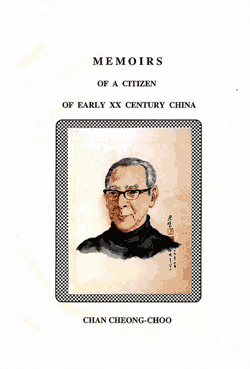 But this is flawed. Having been in Shanghai on the day Zeng Zhongming was killed, Chan Cheong-choo was summoned to Hanoi by Wang Jingwei the next day. Chan was responsible for making arrangements to transport Wang in secret from Hanoi to Shanghai by boat, and accompanied Wang on the journey. The details are recounted in Chan’s Memoirs of a Citizen of Early XX Century China, including a hand-drawn map showing dates and various stops along the way, which disprove the book’s version of events. Omitting Chan as the primary source and other firsthand material is regrettable, since the author’s interpretation of “Night Onboard” relies on specific dates, locations, Wang Jingwei’s thinking and other circumstances at the time. As a result, her Book makes a number of spurious assertions.
According to Chan, Wang Jingwei was reluctant to board a Japanese ship when making the voyage in order to “maintain freedom of action” (not “precisely to avoid the suspicion of patronage” as the Book alleges) and to steer clear of Chongqing agents. The Wang group left Hanoi on April 24 and boarded a coastal steamer flying the French flag with a French captain at Haiphong. The Book claims “the coastal steamer was wrecked” by a storm en route to Shanghai. But Chan Cheong-choo does not mention that a storm occurred. In his memoir, he says:
…we wondered how it [the steamer] would behave on high seas should we encounter some rough weather.
Would Chan have written the above if the steamer was in fact “wrecked” or if they were “rescued?” As planned in advance, the steamer rendezvoused with the Japanese ship Hokko-maru, (misspelled as “Hikkomaru” by Yang) at Hainan which eventually took them to Shanghai. They arrived on May 7 (not May 6, as the Book claims). Chan recalls miscommunication and faulty equipment causing a delay in their rendezvous with the Hokko-maru; he also mentions a detour to Hong Kong to replenish food supplies and encounters with the police. In “An Account of My Thoughts,” an article published in Japan cited by the author, Wang Jingwei recalls high winds and big waves during the voyage, but does not mention a “wrecked” ship or a “rescue” by a Japanese ship. This corroborates Chan Cheong-choo’s account. When using the article to promote her hypothesis on Wang’s intentions and motivations, the author completely ignores Wang’s own description of the voyage. Disregarding Wang as a source is further discussed here.
Aside from not being an eyewitness, citing Gao Zongwu as a source for this episode is undermined by the fact that Gao, along with Tao Xishing (1899-1988), betrayed Wang Jingwei by disclosing the details of peace negotiations with the Japanese and defecting to the Chiang Kai-shek camp during this time. Gao Zongwu’s credibility has been questioned by Jian-yue Chen in “American Studies of Wang Jingwei: Defining Nationalism”:
…how much can we trust what Gao said given his close relations with Jiang Jieshi [Chiang Kai-shek]?
Professor Chen continues,
Gao was widely reported by Chongqing mass media to have parted with the Chinese peacemakers for he refused to accept the Japanese harsh conditions for peace. Yet, it was no secret that Gao left Wang and his peace movement for he failed to win the position as foreign minister.
Continuing to cite Gao Zongwu, the Book concludes that the Hanoi to Shanghai voyage “was another publicity disaster” without explaining how a “publicity disaster” was possible when the voyage occurred in secret, in other words, not publicized?
Flawed Theory Based On Dates
The Book poses a theory that, for political reasons, Wang was duplicitous about the dates that he assigned to the 1939 poem the author entitles “Night Onboard.”
She begins by stating, “there are two potential dates for this poem,” — May and June. The author writes:
The original draft of the poem, preserved in the Hoover Institution, is undated. According to a Japanese-language essay titled “An Account of My Thoughts” published under Wang’s name in July 1941, it was written on his way from Hanoi to Shanghai. Since the small French steamer was wrecked during the storm, Wang was rescued by the five-thousand-ton Hikkōmaru…
The essay [“An Account of My Thoughts”] declares that the poem was written in May, the very night of the changing of ships. This has to be a mistake, since the night in question was April 28. It could of course be a glitch of memory—unless it was a Freudian slip, namely the poem was actually written in early May, but in Wang’s mind it was written on that fateful night, a date that gives the poem more emotional urgency and immediacy.
But according to Chan Cheong-choo’s memoir, Wang was not “rescued”, the steamer was not “wrecked”, and the changing of ships occurred one day later, on April 29. The author continues:
The second date is “June 1939,” which has been added to the copyist manuscript of Sweeping Leaves, possibly in early 1941 in preparation for its publication. Both the Shanghai edition of Poetry on the Double-Shining Tower, published in August 1941, and a separate publication of the poem in Accord Monthly in October 1941 contain this date. This date also appears in the posthumous edition. Since Wang flew to Japan on the first of June, the only sea voyage he made in June 1939 was on his way back to Tianjin, after his meetings with the Japanese cabinet.... Given the very different circumstances of the two sea journeys, it was unlikely that Wang could have confused them. If the reason for the discrepancy is not mnemonic, it must be intentional.... It suggests that in the year 1941, Wang assigned different dates to this poem in publications meant to be read by Japanese or Chinese audiences, each bearing special implications.
The author theorizes that Wang Jingwei assigned two different dates for the creation of “Night Onboard” — May for the Japanese and June for his Chinese audience — “each bearing special implications” and the two dates “must be intentional”. She concludes by saying:
The fact that two dates exist for two separate audiences speaks of the performative nature of Wang’s lyrical authenticity.
She considers her “two different dates for two separate audiences” theory to be a new discovery. Listing several other historians who have cited “Night Onboard” in their writings, she remarks:
None of the historians, however, have paid much attention to the disparate dating.
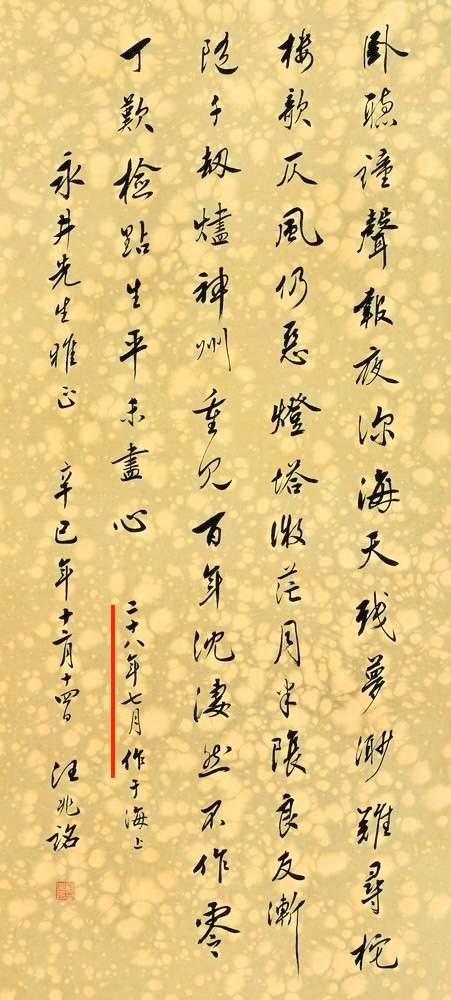
If so, the reason is simple. The author’s “two dates exist for two separate audiences” argument is misguided. All of the known examples of “Night Onboard” calligraphed by Wang himself indicate that the poem was authored in July, 1939 — not in May or June as the author supposes.
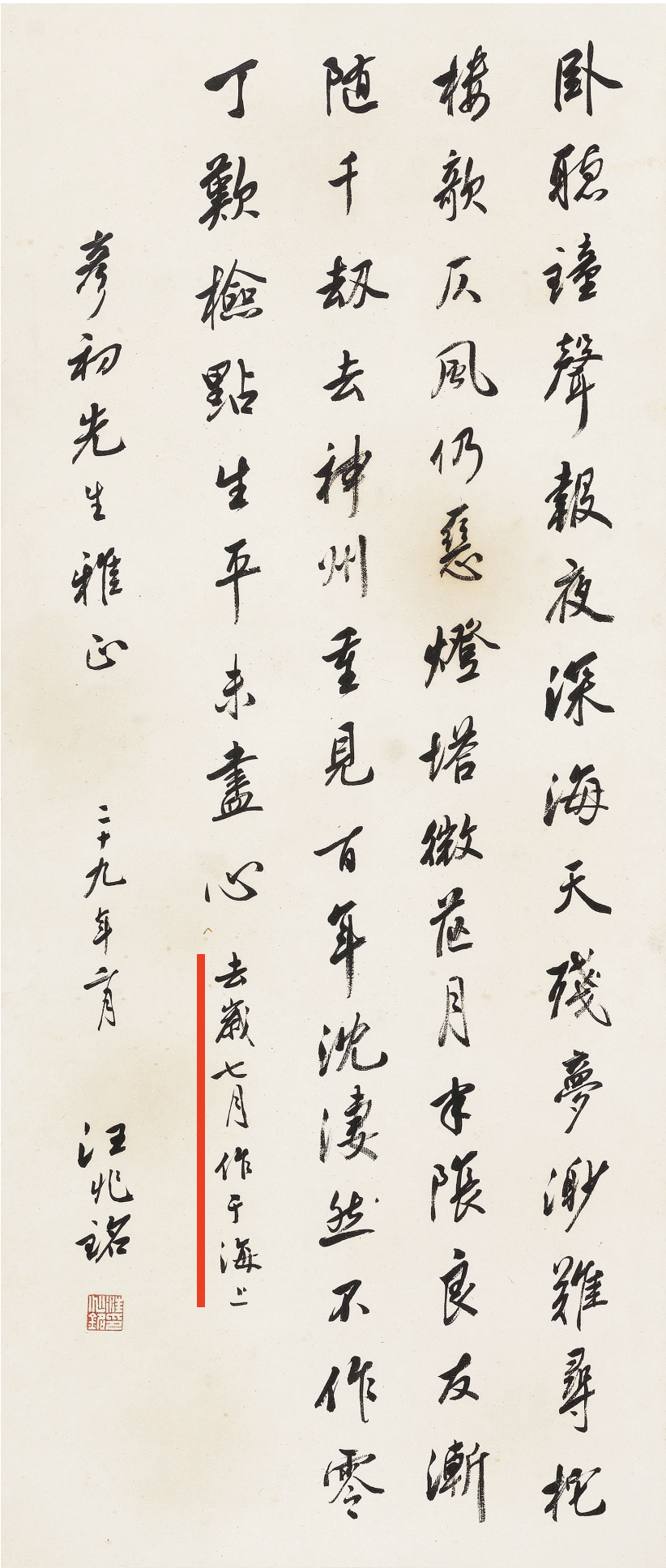
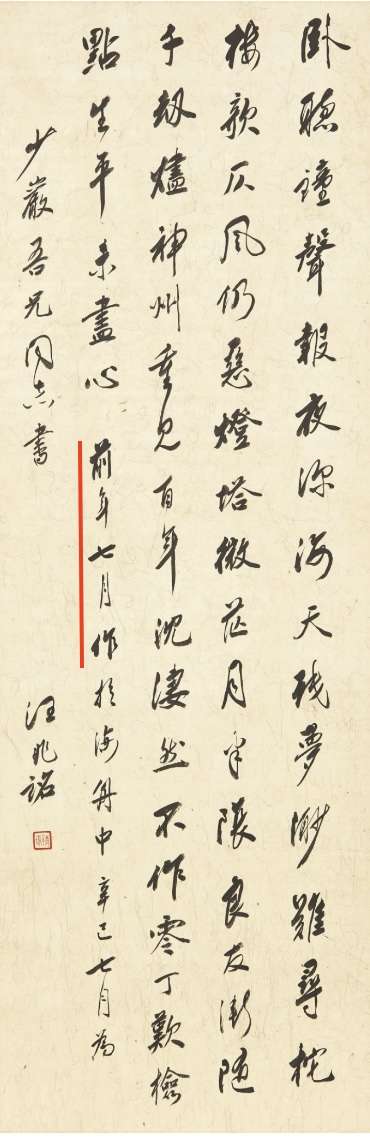
A click of the mouse reveals that Wang Jingwei dedicated no fewer than four calligraphy scrolls of “Night Onboard” to individuals both Chinese and Japanese and indicated on each scroll that the poem was composed in July, 1939. They were gifted to:
- Mr. Yanchu, calligraphed in February, 1941;
- Cao Zongying (Shaoyan), a close associate and secretary, calligraphed in July, 1941;
- a Japanese person, likely the politician Ryūtarō Nagai (1881-1944), calligraphed in December, 1941; and
- Wang Jingwei’s daughter Wang Wenxing and son-in-law Ho Mang Hang, calligraphed in December, 1941. See Wang Jingwei’s Poetry Volume II, page 347.
.jpg)
If, as the Book theorizes, Wang Jingwei for political reasons “intentionally” assigned two different dates for the creation of “Night Onboard” — May for the Japanese and June for the Chinese — what “special implication(s)” does the July, 1939 date signify?
Is this a mere oversight or yet another example of the author’s selective use of source material to reach a predetermined conclusion? Ignoring key evidence in an effort to advance a false narrative only serves to distract from the poem’s literary significance and Wang’s own meaning and intention.
The Reorganized National Government (RNG)
The Book asserts:
The RNG was founded on pretense.
But for the 200 million people who lived in the occupied areas there was no pretense. The author hides from her readers the actual nature of the RNG as Wang Jingwei and its leaders had intended. Yet:
- Since the day of its establishment, the RNG announced its goals and followed up with published reports of its accomplishments.
- For some years now, researchers have been sharing their findings on the subject, including the 1998 “Living the Limits of Occupation in Nanjing, China, 1937-1945” by Mark S. Eykholt, who shares detailed research and 44 interviews conducted with those who lived in Nanjing during occupation. The author is familiar with Eykholt’s work his other work is referred to.
- Occupants of the Japanese-conquered territories have in fact been publicly discussing their experiences on YouTube, the BBC program “Witness History” and elsewhere.
Yet these published works are missing from Poetry, History, Memory. The Book devotes an entire chapter “The Impossibility of Remembering Nanjing” while making little effort to seek out and listen to people who do remember. Remembering Nanjing using the poetry cited may be difficult, but listening to survivors who do remember Nanjing at that time is easy.
When the scholars Yu Ying-shih (1930-2021) and Yeh Chia-ying (1924-2024) — who lived under Japanese occupation — are mentioned, their “defense of Wang Jingwei” and praise for his poetry are dismissed as a self-soothing product of their own “living with ambivalence.” The author is apparently not satisfied with their analyses and opinions because they praised Wang’s poetry but did not denounce the poet.
Readers of the book would have benefitted from a more balanced approach that includes accounts from living witnesses who have given testimony. While the author tells her readers that Wang Jingwei failed “to emerge gloriously out of the darkness,” survivors of the occupied territories who have spoken up disagree.
Rather than report the memory of actual witnesses, the author cites Iris Chang’s book The Rape of Nanking in her lengthy discourse on “amnesia and aphasia,” but neglects to mention that the Chang book focuses on the Nanjing Massacre, which took place in December 1937, before the RNG was established. The Rape of Nanking does not even mention Wang Jingwei’s name, although it does mention Chiang Kai-shek, who was in charge.
Excluding Wang Jingwei’s Firsthand Accounts
The author devotes many paragraphs to describe what she believes is missing from Wang’s speeches while ignoring what is actually present. When Wang’s writings or speeches are mentioned, the author often interprets, describes, makes assumptions and paraphrases rather than use direct quotes. She excludes key passages that might undermine her fundamental premise, as illustrated in her description of the 1939 essay “One Example” in which Wang calls for his words to be read and re-read after his death, not “consigned to oblivion.” Another notable example from the 1940 essay “Nationalism and Pan-Asianism” is:
National consciousness is not enough. We need to wake up to the communists’ devious tactics to “unite the people” causing people suffering much more devastating than foreign invasions. (Wang Jingwei’ Political Discourse, Vol. I, pages 437)
This is missing from the Book’s otherwise detailed summary of the article. This omission does its readers an injustice, because it illustrates Wang’s clear stance against communism which remains consistent.
The author accuses Wang for failing to extol:
China’s cultural superiority or its uniqueness that in his earlier writings had served as the foundation of national pride.
Yet, in Wang’s 1934 speech (Wang Jingwei’ Political Discourse, Vol. I, pages 334) “The Destitute and the Parvenus,” he acknowledges:
That China has its own unique culture is indisputable.
Using “the Destitute” as a metaphor for China, Wang states that while many Chinese people cling to past glories, becoming lazy and arrogant, the Japanese (the “Parvenus”) are decisive and determined. In the speech, Wang describes Japan’s response to the 1853 Perry Expedition as an illustration of the Japanese people’s resolve and hard work to meet a new challenge, not adherence to past glories that had contributed to China’s decline. As an example, Wang observes that praying for rain is easier than undertaking disaster relief during a drought. Wang calls for such attitudes to be abolished, asking the Chinese people to look forward, not backward:
Our ancestors’ glories cannot wash away our shame; when we leave arrogance behind and work hard, we can then be a modern nation.
The author, who identifies as “a student of classical Chinese poetry” and complains about “historians’ negligence of poetry” would benefit from a better understanding of history.
—
Zhang Jiangcai’s 1943 publication Wang Jingwei xiansheng xingshilu is cited in the Book’s account of how the would-be assassins in the 1910 plot against the Prince Regent Zaifeng were discovered, with a note from Zhang:
There are different accounts on exactly how they were discovered…
Since the 2019 publication of Wang Jingwei: His Life, Ideas & Beliefs, the problem has been clarified by Wang Jingwei himself on page 216. Their plot was exposed by barking dogs. While the author does cite this book as a source elsewhere, she chooses to disregard Wang’s own words here and alleges:
A vigilant neighbor tipped off the police.
But, as Wang Jingwei explained, the plotters chose the location precisely because it was desolate and uninhabited, to avoid hurting other innocent people. If so, how would there be a “vigilant neighbor”?
The Book is full of interpretations and analyses, but her use of source material virtually excludes her subject’s own accounts or points of view. As Ho Mang Hang says in the Foreword of Wang Jingwei’s Political Discourse:
Although one’s own writings sometimes may not suffice as all the material necessary to study him [Wang Jingwei], using his political writings to follow his thinking and verify his action is the correct way.
Wang Jingwei left behind a wealth of material that we can use to better understand his ideas, motivations and beliefs. Minimal use of this primary resource leaves readers with an incomplete, one-sided portrayal.
—
In “The Third Debacle” the author says “He [Wang Jingwei] wrote an autobiography…” She is referring to “Draft of an Autobiography,” a manuscript published in Wang Jingwei: His Life, Ideas & Beliefs (pages 202-351) which includes a preface by the Wang Jingwei specialist historian Wang Ke-wen. In the preface, Wang Ke-wen describes the draft as an unedited outline, often without paragraph breaks, and sometimes annotated. He believes it was likely written during Wang’s sojourn in France after leaving office at the end of 1927.
In the same preface, published five years before Poetry, History, Memory came out, Wang Ke-wen — who was among the first handful of scholars who viewed the 124-page handwritten manuscript — suggests that The Inner History of the Chinese Revolution and Wang Ching-wei: A Political Biography by T’ang Leang-li has much in common with the “Draft of an Autobiography.” Wang Ke-wen credits Ho Mang Hang for verifying that the 124-page handwritten manuscript was Wang’s work after viewing it for the first time in 1994, adding that Ho was one of the very few people qualified to do so.
Wang Ke-wen also points out:
This manuscript by Wang Jingwei is definitely an extremely precious historical document. The materials that scholars rely on are mostly influenced by the hindsight of Wang becoming a “traitor”, and their recollections of Wang are often very negative; since they cannot hear Wang’s self-defense, they can only accept one-sided words. Now that this manuscript has been published, at least some balance can be achieved.
But the Book’s author describes the manuscript inaccurately and dismissively:
He [Wang Jingwei] wrote an autobiography en route to France, which served as the basis of Tang Liangli’s 湯良禮 (1901–1970) English biography of him, published in 1931 in an international campaign to boost Wang’s prestige.
Neither Wang Ke-wen nor Ho Mang Hang are credited or mentioned in the reference to this “autobiography.”
Questionable References
The inclusion of references without confirmed sources causes the reader to question the author’s reliability as a narrator. For example:
- In “The Denouement,” the author writes that Wang – “in a gesture of self-reprimand, confided to his eldest son Wenying, “If China can still be saved, I only hope that my reputation will be ruined and our family broken.” But, in the very next sentence, the author concedes that she does not know the original source of this quote, does not know when Wang made this statement and is not even sure to whom Wang was speaking, adding the disclaimer “witness memory should be treated with caution.” So why include this spurious comment at all?
- To prove the point that “the presence of these collaborators in Nanjing…was perceived as an episode of shame in the history of the city” the Book takes great pains to focus on a “patriotic project”: a pair of effigies in Chongqing designed to denigrate Wang Jingwei and his wife. However, since the end of January, 2023, the effigies — “monuments of shame” have been removed. The Book makes no mention of this. To date (April, 2025), these effigies featured with close-up photographs have not reappeared.
- A footnote to a description of Wang Jingwei’s time at the Nagoya hospital cites its source as:
188. Ōta Mototsugu, “Yisheng de huiyi.” Ōta later wrote a dissertation on this disease.
In the bibliography, where the reader expects to find more information about Ōta Mototsugu’s “Yisheng de huiyi” (doctor’s recollections) we see the following:
Ōta Mototsugu 太田元次, “Yisheng de huiyi” 醫生的回憶. In Wang Jixin xiansheng xingshilu quanbian 汪季新先生行實錄全編, edited by Zhu Zhihang (sic) 朱之珩, 631–34. Hong Kong: Huaifeng shushe, 2017.
This entry appears to indicate Ōta Mototsugu wrote an article in Chinese entitled “Yisheng de huiyi” 醫生的回憶, which has been included in a book edited by Zhu Zhiha[e]ng. The truth is, Ōta Mototsugu wrote two books on the subject in Japanese, not Chinese:太田元次軍医の汪兆銘看護日誌抄 : 汪兆銘客死抄から抜粋 and 戦前派病院長の回顧録. It appears that Zhu Zhiheng or someone else at Huaifeng shushe translated the Japanese work into Chinese and included it as an essay in a book and published it, although the Book does not indicate the original work by Ōta Mototsugu is a published book, and “Yisheng de huiyi” 醫生的回憶 is a translated work, with a Chinese title. This citation is therefore more confusing than useful.
Was the translation authorized by the author Ōta Mototsugu? Was it a faithful translation? Perhaps a more relevant question is: Why does the author not use the original books by Ōta Mototsugu as a source? The bibliography is replete with other resources in Japanese. Once again, we are puzzled by the preference for secondary source material.
The Book’s inherent bias manifests itself in its language and selective disclosure.
The tactic of inserting a negative comment at the end of a paragraph, even when the comment makes no connection to the rest of the paragraph, repeated many times, is further evidence of the author’s inherent bias. This practice is especially noticeable in the chapter titled “The Traitor.”
Few readers will be surprised that an academic book published by a university press offers an abundance of specialized language. But, in this Book, the march toward pre-determined conclusions relies too often on hackneyed terms such as “weaponize” in an effort to impose a negative connotation on something without actual evidence. Readers are greeted with “weaponized memory,” “weaponized remembrance,” “weaponized charm,” “weaponized charisma,” and “weaponized sincerity” to avoid presenting facts that might be interpreted as a positive portrayal. For example, the author concludes that Wang “deeply impressed them [the Japanese] with his trademark elegance and sincerity” in April 1939 because of “Wang’s weaponizing his intimate charisma.” This and his “apparent altruism and sincerity” suggest that Wang’s politics was all a deliberate act.
The Book would have us believe that Wang Jingwei was putting on a show the entire time: the assassination attempt on Prince Regent was, in the author’s eyes, a “publicity stunt;” while the RNG was “founded on pretense” and fueled by Wang’s “weaponized” charm, charisma and sincerity. The portrayal is so exaggerated that it often resembles the punitive narratives that have littered modern Chinese histories for the past half century.
Conflating Wang Jingwei’s Poetry with Politics
The educated elite in China generally agree that Wang Jingwei was one of modern China’s greatest poets. Summarizing four of Wang’s most well-known poems 被逮口占, the Book describes,
…their indisputable power and memorability help to push them into a stratosphere of cultured expressions, achieving the unofficial status of miniclassics, instinctively recalled and recited by educated Chinese in varying contexts.
Reading Wang’s poetry leads to a better understanding of the man, says the author, because
…poetry conveys a higher level of historical truth by articulating emotions lost in historical narratives.
and,
Poems are active biographers of their authors’ public lives…
Yet the author contradicts herself by saying,
The reductionist portrayal of Wang as an identical twin of his poetic persona, however, is a precarious reading strategy.
Similar contradictions appear elsewhere in the Book.
Conflating the poetic Wang with the historical person is especially problematic given the fact that Wang Jingwei himself is on record disagreeing with the author’s contention that understanding the poet is essential to understanding the man. In the essay titled “Autobiographical Draft,” Wang declares:
My essays and speeches are the truest form of my life story. There is no need for any other autobiography.
But conflation seems to be what this author must do. If we were to accept her contention that Wang Jingwei in his last wish asked to be solely remembered through his poetry, the rest to be consigned to oblivion, then poetry is all there is left. After all, she argues,
…a poetic text may consist of “a creative cacophony” of voices, resisting a singular interpretation. Allusions are inherently ambivalent, open to multiple dimensions of exegesis.”
In other words, we can read into this historical person through his poetry as we wish. It is surprising that the author does not recognize that trying to erase Wang Jingwei’s political thought as he articulated it himself does not work. One obvious reason: in addition to poetry, Wang’s voluminous essays, speeches and other writings will continue to be preserved, studied, and read. Books about Wang will continue to be published offering historical judgments that are more thoughtful, relevant and reliable than the Book’s portrayal. Examples such as Wang’s sentiments shared with his daughter, private letters and autobiographical works allow readers to understand Wang Jingwei the person without filter and bias. Conjecture and guesswork should no longer have a place in Wang studies, especially in works produced by academia.
Wang’s Cause of Death
In the introduction, the Book states without citing a source:
The cause of death was complications resulting from the removal of a bullet rusting in his spine, courtesy of a patriot who shot him three times on November 1, 1935…
Yet later in the same book, the author writes:
The doctors finally concluded that Wang suffered from a rare disease, multiple myeloma, a cancer of the bone marrow.
and
Pneumonia, the doctors’ greatest fear, was what finally claimed him.
So, what is the author telling us? Was the cause of death cancer, or surgery to remove the bullet, or pneumonia?
There should be no cause for confusion. The cause of Wang’s death has been thoroughly covered in published memoirs by his son-in-law and Wang’s doctors.
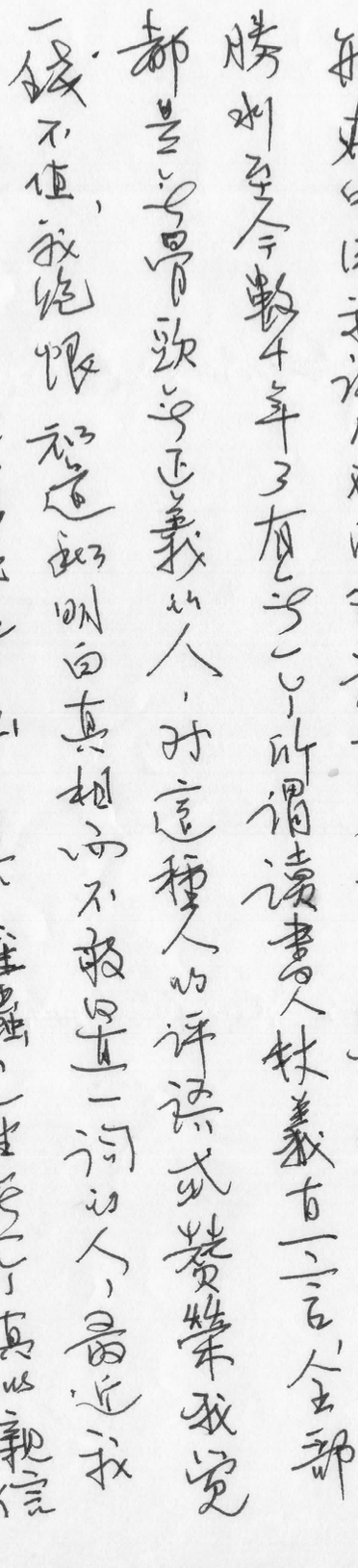
Wang Wenying letter to Ho Mang Hang
As a publisher of Wang Jingwei’s essays, speeches and poetry, we are duty-bound to point out the Book’s most blatant problems, based on primary source material that has already been published for everyone to see. Regrettably, Yang has missed the opportunity to create the objective biography that she purports to write.
A letter Wang Jingwei’s eldest son Wenying wrote to Ho Mang Hang contains a brutal indictment of “worthless so-called scholars who know the truth yet choose not to speak up are most detestable.” Nevertheless, as we recall the scholarship found in this brief overview, we remain optimistic.
I listened with disbelief when my mother told me how my grandfather’s writings had been altered in publications with added or subtracted words even during his lifetime. My grandfather himself spoke about works falsely attributed to him. Nearly a century later, a student of Wang Jingwei studies told me that it is very difficult to find a completely neutral and holistic biography of my grandfather within academia. Could this be true?CINDY HO
Postscript: The author’s undisclosed Confucius Institute affiliation is not mentioned, because this response addresses issues in the book, and is not a personal attack on the author.
now available as individual e-books and in print