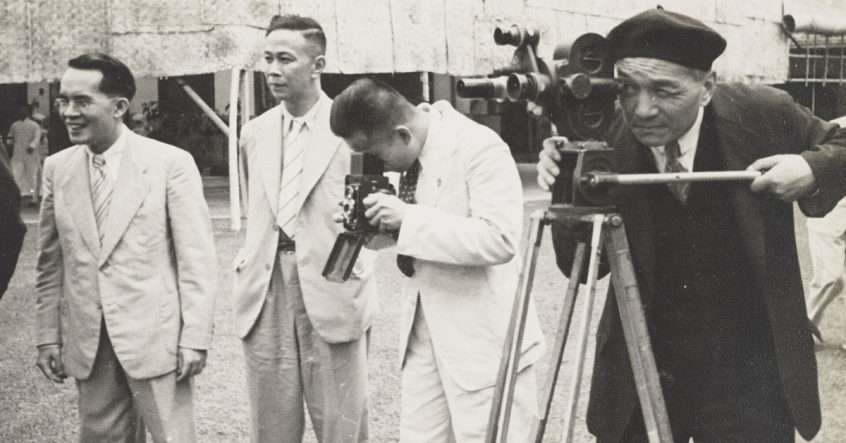
Chu Minyi using a movie camera. On the left is Lin Baisheng. (Wikimedia Commons)
 An early member of the Tongmenghui, Chu Minyi first met Wang Jingwei in 1911, after the Wuchang Uprising and Wang’s release from prison. The following year, Chu and Wang continued their acquaintance and became close associates in France, where Chu pursued his education and established the Institut Franco Chinois at Lyon University along with Wang Jingwei and other Chinese associates. After graduation from the University of Strasbourg in 1924, Chu returned to China, married Chen Bijun’s younger sister Chen Shunzhen and held many positions in education and in government, serving as Wang’s chief secretary in 1932 and as foreign minister and ambassador to Japan during the Nanjing Government. In addition to his political activities, Chu was an advocate for physical fitness and sports, especially the practice of Taiji chuan (shadow boxing). After Wang’s death in 1944, Chu became governor of Guangdong Province. He was detained in Guangzhou with Chen Bijun in 1945, declared hanjian (traitor to China), imprisoned and sentenced to death in 1946.
—
A native of Nanxun, Zhejiang, Chu’s original name was Qingsheng and Mingyi (literally meaning: relics of the Ming dynasty). His courtesy name was Chongxing. He changed his name from Mingyi to Minyi while studying in France.
With financial aid from a fellow villager Zhang Jingjiang (who would later become one of Chaing Kai-Shek’s strongest supporters), Chu Minyi studied in Japan and later in France, earned a doctoral degree in medicine and a second degree in pharmacy from University of Strasbourg. In 1906, while en route to France, Chu passed through Singapore and, along with Zhang Jingjiang, joined the Tongmenghui. While in France, Chu established the L’mprimerie Chinoise, along with Li Shizeng and Wu Zhihui, which published weekly newsletters advocating for democratic revolution and anarchism. Upon his temporary return to China in 1911 to join the Wuchang Uprising, Chu met Wang Jingwei after Wang’s release from prison and came to know him well. In 1912, Chu returned to France, where he established the Institut Franco Chinois at Lyon University along with Wang Jingwei, Li Shizeng, Wu Zhihui and Cai Yunpei and served as deputy headmaster of the Institute. This same group also advocated for the “Diligent Work and Frugal Study” movement among overseas Chinese in France.
In 1924, after completing his studies, Chu Minyi married Chen Bijun’s younger sister Chen Shunzhen. The wedding took place in Guangzhou and was officiated by Wu Chaoshu. Hu Hanmin was a witness, and Liao Zhongkai and Gu Yingfen served as “introducers” during the ceremony.
 During his lengthy career, Chu Minyi served in many positions: as professor and director of the medical school at Guangdong University; as headmaster at the Institut Technique Franco-Chinois de Shanghai; as chief secretary of the Guomindang Central Committee; and as a member of the Guomindang Central Executive Committee. In 1932, when Wang Jingwei became the premier, Chu Minyi served as Wang’s chief secretary. After the first assassination attempt against Wang Jingwei in 1935, Chu Minyi resigned his position. In 1940, while Wang Jingwei was setting up the Nanjing Government, Chu Minyi served as vice premier as well as foreign minister and was later appointed by Wang as ambassador to Japan. After Wang died in 1944, Chu became governor of Guangdong Province. The following year, Chu was arrested in Guangzhou with Chen Bijun, was declared hanjian (traitor of China), and died by firing squad in 1946.
Because he was good friends with his early benefactor Zhang Jingjiang, who was also one of Chiang Kai-Shek’s strongest supporters, and due to his relationship with Wang Jingwei after marrying Chen Bijun’s sister, Chu Minyi found himself in an embarrassing position in the Wang/Chiang dispute. For this reason, Chu adopted a low-key attitude when conducting his affairs. Still, they remained close. When Wang home in Nangjing was destroyed by the Japanese air raids in December, 1937, Chu lent them their own home on Yihe Road. Even though Chu assumed many important government positions, he was not enthusiastic about politics and preferred to spend his time in the practice of Taiji chuan (shadow boxing), calligraphy and Chinese opera. During the 1930s, while serving as chief secretary of the Executive Yuan, Chu advocated for physical fitness and sports. During the 1940s, under Wang’s Nanjing Government, Chu took the directorship of the Sino-Japanese Cultural Society and participated in other cultural associations. He enthusiastically promoted kite-flying, Jianzi kicking (Asian shuttlecock game), and other sport activities. He also developed his own martial arts techniques as a way of promoting traditional Chinese sports. These endeavors led to others believing that Chu “did not engage in proper work.”
Out of a population of 450 million, only 10-20% actually produce, benefitting 80-90% of the people. In order for everyone to be able to produce, aside from acquiring considerable knowledge and skills, people must strengthen their bodies and ability to endure hardships. CHU MINYI
Throughout his life, Chu Minyi was dedicated to promoting sports, and had authored many articles and gave speeches on the subject. For him, promoting sports was a means to rejuvenate the Chinese nation, rather than focusing on competition. In 1937, he published “My Opinions on Reforming Sports and Striving to Popularize Sports” in the journal Teaching and Learning, pointing out China’s production problems:
Chu Minyi believed that only sports could give a nation a sound body, so that it could have a sound spirit and a healthy mind, and then it could “further knowledge, carefully study affairs, invent machines and create tools” and enhance national productivity. For him, these were the true purpose and significance of promoting sports.

chu minyi at 1946 trial
During the Nanjing period, Chu Minyi and his wife lived across the street from the Wang family and dined with them often. He was referred to as “Eighth Uncle” to the Wang children. Chu, who was at one time a trustee at the Shanghai School of Fine Arts, excelled at calligraphy and was considered a man good with his hands. After the war and his arrest, while he was imprisoned, Chu practised the calligraphy of Liu Gongquan, a famous Chinese calligrapher from the Tang dynasty. He made pen holders, paper boxes, tea tins and small utensils for members of his family by gluing together the paper he used to practice calligraphy with leftover congee (rice porridge) served in prison. In his final confession in 1946, Chu Minyi emphasized that his reason for joining the Peace Movement was due to his belief that Wang Jingwei and Chiang Kai-shek were divided, the former working for peace whilst the latter focused on war. For Chu, the Peace Movement was conducted with the acquiescence of Chiang Kai-Shek.
I have followed both “Misters”(Wang and Chiang) for many years. On the one hand, I am happy that the mission to save the country has succeeded. On the other hand, I regret the difficult way in which it was accomplished. If I am deemed guilty, I will follow Mr. Wang to the underworld and eagerly await my punishment. I have no regrets.CHU MINYI
In his confession, Chu Minyi described his relationship with Wang Jingwei as follows:
Mr. Wang and I were not just related by marriage, we were revolutionary comrades. When we studied in France, we were classmates. In terms of learning and ideology, he and I were like teacher and student. Serving the country and the Guomindang, we were like senior and junior officials. I admired his frugal and diligent character very much. I admire even more his bold and powerful fervor for the Party, for the country and for the people, to the extent of disregarding his own life.
Chu also said that while Chiang Kai-Shek’s pro-war stance and Wang Jingwei's peace movement were different, both paths were intended to save the country.
Unfortunately, Mr. Wang had to endure humiliation and died an untimely death. He was not able to see how his country and people were saved. But I know that Mr. Wang must be smiling in the underworld. I have followed both ‘Misters’ (Wang and Chiang) for many years. On the one hand, I am happy that the mission to save the country has succeeded. On the other hand, I regret the difficult way in which it was accomplished. If I am deemed guilty, I will follow Mr. Wang to the underworld and eagerly await my punishment. I have no regrets.
This statement notwithstanding, Chu Minyi was sentenced to death.
Before he faced the firing squad, Chu and a fellow prisoner practiced one final round of Taiji chuan, after which he said final farewells to Chen Bijun and others in prison.
In 2021, Chu Minyi’s children published Dr. Chu Minyi—A Definitive Biography.
References
Chu Youyi, Chu Minyi boshi shengping, unpublished manuscript.
Ho Mang Hang. He MenghengYunyan sanyi (Cloud, Smoke, Scattered Memories), Eight Corners Books, 2024.
The Nanjing Municipal Archives, ed. Shenxun Wangwei hanjian bilu (The Trial Transcripts of the Collaborators of the Wang Jingwei Puppet Regime). Nanjing: Jiangsu guji chubanshe, 1992.
Jin Xiongbai. Wang Jingwei de kaichang yu shouchang (The Rise and Fall of the Wang Jingwei Regime), 5 Volumes. Hong Kong: Chunqiu chubanshe, 1959-1964.
now available as individual e-books and in print