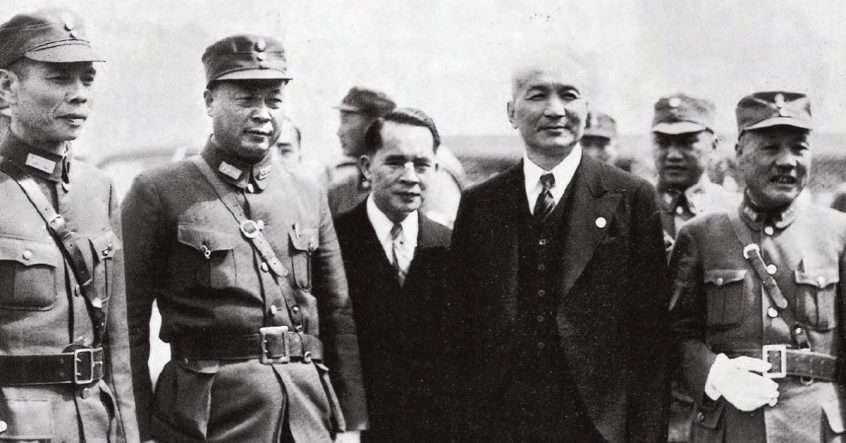
Lin Baisheng and Chu Minyi welcoming Wu Huawen to Nanjing in 1943. (Wikimedia Commons)
 A native of Xinyi, Guangdong, Lin Baisheng’s courtesy name was Shiquan. He studied at Lingnan University and the Moscow Sun Yat-sen University. After returning to China, he worked for Liao Zhongkai until Liao was assassinated, after which Lin became Wang Jingwei’s secretary. Later on, he managed propaganda affairs for Wang. In 1930, Lin launched the South China Daily newspaper in Hong Kong. Four years later, Lin served as a member of the Legislative Yuan of the Nationalist Government. In 1940, after the Nanjing government was established, Lin managed China Daily in Nanjing as the government’s news organ to publicize the Peace Movement. He also served as the head of the Propaganda Bureau and the executive director of the Central Newswire Agency. He later became the Governor of Anhui. As the head of the Propaganda Bureau, Lin pushed aggressively for the purging of Communists in the countryside (qingxiang) and supported the New Citizens’ movement, serving as a member of the executive committee and the secretary-general of the New Citizens’ movement. He was also the secretary of both the Chinese Youth Corps and the Chinese Model Youth Corps. After the war with Japan ended, Lin Baisheng and Chen Gongbo were exiled in Japan temporarily but soon returned to China. In 1946, Lin was declared a hanjian (traitor to China) and executed by firing squad.
—
Early in his career, Lin Baisheng worked as the chief of student activities at the Zhixin School, and in that role accompanied 18 Chinese students to study at the Moscow Sun Yat-sen University. His future wife Xu Ying, among one of those students, was considered “the most beautiful female student at the school.” While serving as Wang Jingwei’s secretary, Lin and Xu frequently visited and dined at the Wang home; and Wang looked after Lin as his own student.
In 1927, Lin accompanied Wang to France, where he founded the journal Newsletters of the Overseas Students in Europe. In early 1938, Lin Baisheng, Fan Zhongyun and Zhu Pucheng founded the International Editing and Translation Agency and the Wailan shudian (Azure Bookstore) in Hong Kong, which served as the Hong Kong branch of the Society of Art and Literature Studies established in Hankou by Zhou Fohai and Tao Xisheng. The Agency was responsible for editing and translating works on international affairs for the Guomindang leaders, such as Wang and Chiang Kai-shek.
We are not ashamed of our convictions that peace is good for humanity, while war destroys— the victor no less than the vanquished.LIN BAISHENG, Speech given on March 20, 1940 at formal dinner in honor of journalists in Nanjing. East Asia Review, March 25, 1940
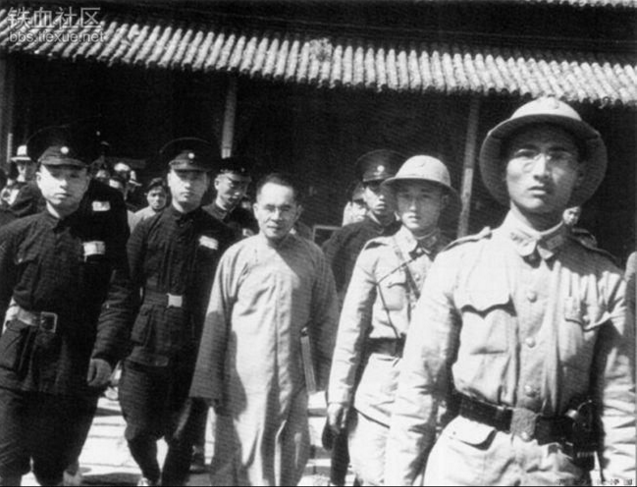
Lin Bosheng was sentenced to death on May 31, 1946
On December 29, 1938, Lin and Mei Siping jointly represented Wang to publish Yandian (the December 29 Telegram to Chiang Kai-shek) in the South China Daily, which outlined the principles of Wang’s peace negotiations with Japan. In January, 1939, Lin was attacked in Hong Kong and severely injured for his role in the publication of Yandian. After his recovery, Lin attended the Guomindang 6th National Congress in Shanghai, presided by Wang. Lin also accompanied Wang during negotiations with Sadaaki Kagesa and others focusing on proposed plans for peace. From that point forward, Lin supported Wang’s plans for the Peace Movement and became a key member of the Wang government.
When Lin was managing China Daily in Nanjing, he edited The Collected Works on the Peaceful National Reconstruction by Chairman Wang and other related works. In 1940, Lin founded the Society for Sino-Japanese Cultural Association with Chu Minyi with the goal to promote cultural exchange between China and Japan. Lin was the chief officer during several important trips with Wang. For example, in January of 1940, along with Zhou Fohai, Mei Siping and Chu Minyi, Lin attended the Qingdao Conference with Wang, where they discussed consolidating the Beijing Temporary Government with the Shanghai Reorganization Government. In June of 1941, Lin accompanied Wang to Japan (see the joint declaration with Prime Minister Konoe), which was broadcast live to the Japanese public. In 1942, Lin accompanied Wang to “Manchukuo.”
After the war, Lin was held at the Nanjing Tiger Bridge Prison. In court, he refused to be handcuffed.
I do not accept this! When the time comes, you will see the moral backbone of the educated people under Mr. Wang.LIN BAISHENG
References
Hu Lancheng, Jinsheng jinshi (Autobiography), Yuanjing chubanshe, 2004.
Ho Mang Hang. He MenghengYunyan sanyi (Cloud, Smoke, Scattered Memories), Eight Corners Books, 2024.
Jin Xiongbai. Wang Jingwei de kaichang yu shouchang (The Rise and Fall of the Wang Jingwei Regime), 5 Volumes. Hong Kong: Chunqiu chubanshe, 1959-1964.
now available as individual e-books and in print