Photo shows Nanjing streets with tea houses, broadcast station, train station, Xuanwu Lake, Confucius Temple, taken in 1941, a year after the Wang Jingwei Regime was established. (Shanghai Times, March 30, 1941.)
What did Wang Jingwei aim to accomplish in establishing the Reorganized National Government (RNG)? How did the leaders of the regime view the mission, and how was it executed? What did it actually do, and how was it received by the people that it governed? How did the people live under the RNG?
If the function of the state is to serve its people, we should listen to those who lived under the Wang Jingwei Regime during the Japanese occupation. Here we present a brief overview to provide a glimpse into the economy, daily life, educational and cultural situations in the territories occupied by the Japanese by the time Wang Jingwei established the RNG, as told by those who lived there, and scholars who have studied the topic, which remains little discussed, but is increasingly gathering attention.
On March 30, 1940 when the Reorganized National Government was formed, it released a 10-point policy which Wang Jingwei reiterated in a summary:
The National Government will concentrate its efforts on establishing peace and improving the economy of the nation and the people. Once peace in prescribed regions is successful, nation-wide peace will come as a matter of course. (translation by T’ang Leang-li)
A year later, on 30 March 1941, Wang Jingwei made a broadcast, detailing the RNG’s specific accomplishments one year since its formation: in public finance, manufacturing, industry and commerce, communications, agriculture, cultural development, news agencies, broadcasting, education, social welfare, Japan’s return of cultural objects to China, relations with overseas Chinese, peace and order, military rehabilitation, and so forth. For details, we suggest you read “A Year after the Nationalist Government’s Return to the Capital” in Wang Jingwei Political Discourse. An English translation of the report can be found in T’ang Leang-li’s “The Facts of Peace And Reconstruction” (see references below).
What were the occupied territories?
David P. Barrett writes:
From the Great Wall in the north to Canton in the south, the cities and major towns of eastern and central China were under Japanese occupation, as were the communication routes, primarily railway lines, that linked them.
In the face of the Japanese invasion, some people fled to the interior, but…most would have no choice but to remain where they were. … All of these were under firm military control. … For the great mass of the population in occupied China, there was no alternative to living with the enemy.
In historian David M. Gordon’s assessment:
This reorganized National Government nominally ruled more than one hundred million people in the richest area of central China, which had previously been Chiang Kai-shek’s chief base of support.
Historian Lee Ngok states:
By 1939, China’s most populous and well-developed provinces were occupied. China’s Government was reduced to almost a local regime with its center at Chungking…Wang found himself in control of an area devastated by the war and ransacked by bandits. Many regions within the occupied area were either burnt to the ground or stripped of their economic value and means of production. Thus industrial and commercial activities were reduced to a minimum and economic recovery became Wang’s immediate task.
Although concrete figures are not available, historians agree that the people living in Japanese-controlled areas — a third of China’s territory — comprise more than half of its population.

RNG territories (dark red) under Japan’s occupation (light red) at its furthest extent. (Wikimedia Commons)
Who led the RNG?
Who were the leaders of the RNG besides Wang Jingwei? Why did they choose to participate in the Peace Movement despite adversity and difficulty? Four of Wang’s closest associates — Chen Gongbo, Zhou Fohai, Chu Minyi and Lin Baisheng — each of whom held key positions in the Wang Jingwei regime, all came from different backgrounds and held different ideals and beliefs. But all came together to join in an act that they knew would likely put their own lives and reputations at risk. As historian Hwang Dongyoun writes:
What the leading collaborators had to shoulder during the trials were…not only a sense of moral and subsequent legal responsibilities for their wartime collaboration with Japan…but also deep-seated political antipathy and retribution against them.
Hwang also notes that:
…none of the accused collaborators admitted that they had been “traitorous to the nation…”
and suggests:
Collaboration with Japan, rather than resistance, certainly seemed to have provided the collaborators with a way to save the nation and people when the existing state (the Nationalist Government in Chongqing under Chiang Kai-shek) had failed to do so.
Who benefitted from the RNG?
We are grateful for these documented accounts, which help to fill an important gap in our understanding of this period of modern Chinese history. Taking great pains to ensure their stories are told, these elderly witnesses are tired of being silenced for fear of political retribution or ostracized for having a better life than those who lived outside the occupied territories. The few who have broken the taboo wish to speak for the many others who remain silent.
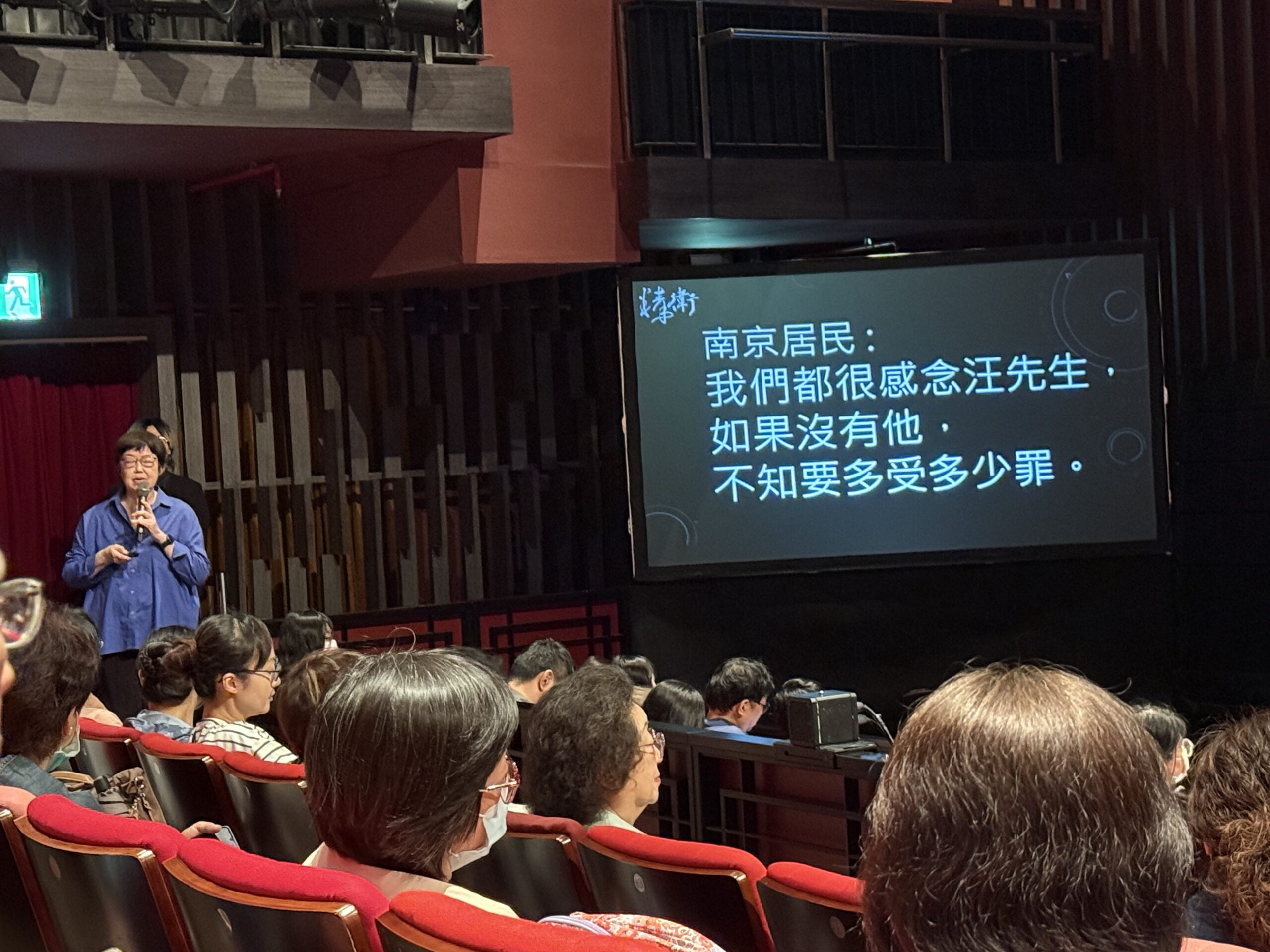 Wang An-qi, playwright and art director of Taiwan’s GuoGuang Opera Company’s production of the 2025 opera “Jing Wei: Feathers Against the Tides” recalls her mother’s account of fleeing alone from Tianjin to Nanjing to find safe refuge under the rule of Wang Jingwei when the Marco Polo Incident broke out: “We are all very grateful to Mr. Wang. Without him, we don’t know how much more suffering we would have endured. When Mr. Wang passed away, we all cried.”
- Since 2021, Pan Chia-sheng has shared his experience of life in Nanjing on Youtube and BBC’s Witness History. Pan witnessed the dramatic change in the security situation in Nanjing and the conduct of the Japanese army before and after the establishment of Wang Jingwei’s government. After Wang Jingwei established his government in 1940, Pang said:
There was no more killing.PAN CHIA-SHENG
- Li Longbiao speaks about daily life and economic situations as an improvement over those who lived outside occupied Guangzhou where he lived as a teenager. According to Li, the economic situation was stabilized and stimulated when the RNG issued the Central Reserve Bank of China notes. The reason he wishes to share his views, Li emphasizes, is to “speak the truth…”
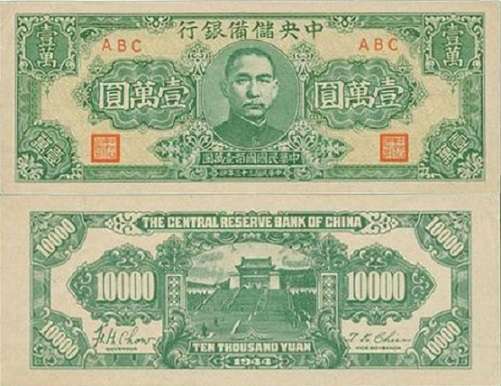
RNG’s Central Reserve Bank of China 10,000 note
- Contrary to popular belief, Chen Yuanzheng who was born in 1929 and lived in the occupied territories thinks Wang Jingwei was a patriot. In an interview, he stated frankly, “Our Republic of China has not perished... Power was in Chairman Wang’s hands, and the flag of the Republic of China was never replaced.” He believed that the Wang regime, even under Japanese occupation, did its best to maintain the dignity of the Chinese people. He also recalled that “life was very good and stable”, with strict military discipline, peaceful and undisturbed civilians, and the chaos caused by the Japanese invasion was mitigated by the establishment of the Wang government. He said, “We ordinary people miss him very much.”
- Wang Jianfeng, the army trooper who served under Dai Li says in his memoir “because the truth in history must be told” that it was only when the RNG came to his rescue that he survived.
- The acclaimed writer Lee Yee’s award-winning memoir devotes chapters to his own experiences:
During the years I lived in Shanghai and Nanjing, society was orderly, business transactions were protected by law, and the economy was prosperous. The gangsters and hooligans seemed to have disappeared. Children were even allowed to sing anti-Japanese songs without problem. Thinking back today, aside from the time of Beiyang Government which I have not experienced, people’s lives under the government of Chinese people were most peaceful and content during the Wang Jingwei government.
Under Wang’s government, people in the occupied territories could break away from the invader’s military rule, gain some breathing space by being ruled by Chinese people.…We had a gramophone at home, and listened to popular songs.…Many movie actors and singers emerged and became very popular; the film industry flourished. Cultural industry usually prospers in an affluent society. Compared with other parts of China, including the large areas ruled by the Guomindang and the Communists, life under the RNG was paradise.
- Yang Peng (1922-2012) who lived in occupied Nanjing for eight years, contrasts life before and after the RNG, and asks in Jian zheng yi sheng:
How would ordinary people have continued their lives in the occupied territories without Wang Jingwei?
- Kan Chen (1928-2020), whose father Chen Gongbo (1892-1946) was executed for his role in Wang Jingwei’s government, recalls life in Shanghai as a teenager in Wang Jingwei: His Life, Ideals and Beliefs. (Note: In the following text, Chen refers to the RNG as the “Nanjing regime” or “Nanjing”):
One of the indicators of serving the country and the people as much as possible was restoring the nation’s vitality. In fact the Nanjing regime soon joined the Japan-Germany-Italy Axis Powers as a means to enhance “peace” between Japan and the occupied areas, to obtain supplies, and to regain concessions. It abolished extraterritoriality at least in name, but in fact, Nanjing did not send a single soldier to war, and Japan did not dare to accept Nanjing’s military assistance for fear of Nanjing’s army defecting in the front lines.
At the end of the War, Japan wanted to use Nanjing’s relationships to negotiate peace with the Allies. Therefore, the control over Nanjing was relaxed even more, and Nanjing also took this opportunity to improve the living standards of the people in the occupied areas, in an attempt to restore their vitality. Recently, some objective historians also believe that at that time, “abnormal prosperity” appeared in the Shanghai, Suzhou and Hangzhou areas. I was already a high school student at that time, and I returned to Shanghai to study. Several high-level schools did not have Japanese courses. Except for Chinese, all subjects, in addition to mathematics, physics and chemistry, even world history and geography used English textbooks. The top ten top students in my grade were all admitted to universities such as Tsinghua, Yenching, and Jiaotong University after the war. “Abnormal prosperity” was found not only in economy, there were also significant achievements in the cultural sectors. The works of women writers in Shanghai flourished, along with popular music.
Read about scholarship in the occupied territories under the Wang Jingwei regime.
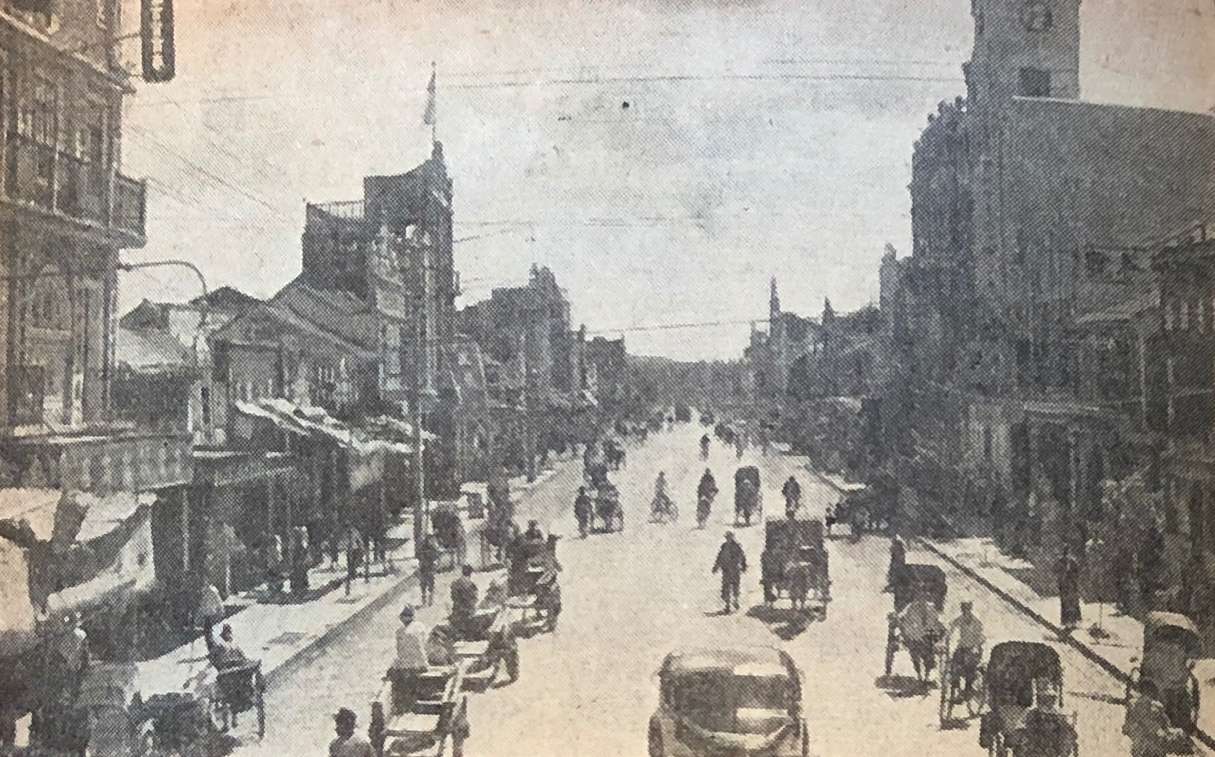
Zhonghua Road in the center of Nanjing. Photo: East Asia Review, September 10, 1940.
What do scholars and researchers say?
Historian Lee Ngok claims in his 1966 thesis:
The main difficulty in research on occupied China is the absence of systematic documentation and the disruption of publications concerned. However, study tours in Malaysia, Singapore and Taiwan prove that source materials can provide ample facilities for scholars interested in this particular topic.
More than thirty years later, Wang Ke-wen laments the paucity of research on the occupied territories among academics in America, Europe, Taiwan and the PRC in two papers written in 2000 and 2002. The reasons, Wang asserts, are different from what Lee encountered in the 1960s, which echo Mark S. Eykholt’s remarks in his 1998 dissertation:
…to look closely at the lives of those in occupied China upsets patriotic narratives and brings out the complications and contradictions of Chinese life during this period.
As for scholarship in Japan, Hsu Yuming says in his 1998 paper, due to the “abundance of archival material, even though research outputs may be limited, they are of considerable quality.” He concludes with a wish for strengthened academic exchanges among the PRC, Taiwan and Japan. In May 2024, Wang Shengxu follows up with an update on the subject covering the period 2000-2022, and writes about Aichi Gaikun University Professor Tetsuo Shibata’s 2009 book:
Using interviews with four people who were educated under the RNG, the author uses the memories of eye witnesses and breaks free from the cacophony influenced by political correctness and nationalism, allowing readers to gain a maximum glimpse of this most complex and obscured true portrayal of this period in history.
We are further encouraged by Professor Hsu, who said on June 29, 2024:
The study of occupied territories had been a taboo subject in the past. But nowadays, there is more research on the subject through the use of diaries, financial accounts, etc.
Here, we introduce a few studies in anticipation of continued research and scholarly study of daily life in the occupied territories under the RNG. We hope the list will grow over time. Please contact us if you can suggest other reliable source material. Since the pioneering works of John H. Boyle, Gerald E. Bunker and Howard L. Boorman are well known to most researchers of Wang Jingwei, we include lesser known works spanning six decades and invite readers to consult the original sources in the references below, which cover aspects of life for those living under occupation such as food, material supplies, economy, leisure, social order, the labor situation, and more:
- Lee Ngok declares in his detailed assessment of Wang Jingwei and the RNG’s efforts to accomplish their mission, particularly in restoring economic stability and law and order:
Wang’s motto of “Peace, Anti-Communism and National Reconstruction” as proclaimed on March 30, 1940 was more than a paper programme.
- Han-sheng Lin writes:
The Nanking government constantly looked for opportunities to strengthen its administration; and the Japanese bombing of Pearl Harbor provided just such a rare opportunity.…In 1942, Wang seized the opportunity to submit a long memorandum to the Japanese government in which he skillfully argued for strengthening the power and influence of the Nanking government and for improvement of living conditions of the people in occupied areas.…This document indicates very well how the Chinese “collaborators,” particularly Wang Ching-wei and his followers, operated for the benefit of the Chinese in the occupied area, and it could lead us to further investigation of the problems of alien rule in Chinese history.
Read the Memorandum in Wang Jingwei’s Political Discourse.
- In “Collaborators and Capitalists: The Politics of ‘Material Control’ in Wartime Shanghai” Wang Ke-wen writes:
By the Spring of 1943 all the factories formerly under “military management,” including textile, chemical, and food-processing plants, were returned to their Chinese owners.
- Wakeman, Frederic E. writes:
Wang Jingwei believed that he could spare his countrymen further grief by terminating the war in the occupied zones, that he could with Japanese help recover national sovereignty over Shanghai from the Western imperialists, and that he could successfully oppose and destroy the Communist movement in China’s rural areas.
- Using archival material, the scholar Lin May-li analyzes RNG’s negotiations with the Japanese occupiers:
The Wang Jingwei regime valued sovereignty and autonomy of governance, and under specific conditions it fought for better treatment for the people in the occupied territories than if they had been directly under Japanese military.
- Jian-Yue Chen writes about economic recovery that became prosperity under the RNG, particularly in Jiangnan area, which “explained its popularity and support among the people in occupied China”:
Although a thoroughly researched work on the life of ordinary people in occupied China is still missing, some primitive and revisionist studies have offered a positive assessment of the economic achievements of the collaborationist government.…Regardless of both Communist and nationalist condemnations or denials, Wang Jingwei’s collaboration with Japan brought forth positive results for his government and for the common people under his rule.
and adds:
Both the nationalist and Communist regimes condemned Wang Jingwei’s collaboration with Japan for betraying national interests, yet neither of them has done much better in defense of Chinese national interests.Jian-Yue Chen
- Suzhou became so prosperous under Wang Jingwei Regime it earned the name “Paradise,” writes Academia Sinica historian Wu Renshu in the 2017 book. By studying four leisure trades in Suzhou, the books aims “to re-evaluate the nature of the Wang Jingwei Regime, clarify its role and influence, and to write a new page in the study of the history of the Republican Era.”
- Joshua H. Howard points out that the Wang regime established an autonomous domain in the socio-economic sphere free from Japanese supervision, and made various attempts to promote production, allowing workers more space to articulate their economic demands:
Contrary to much of the Chinese historiography on occupied Nanjing that emphasizes either social repression or resistance, one finds that state authorities in most cases granted trade unions’ economic demands for higher wages. The state provided workers with a modicum of agency while pressuring commercial associations to accept worker demands.
- Jiangsu Provincial Academy of Social Science researcher Cui Wei writes in a paper that Nanjing, which used to be a cultural and academic center and gathering place for intellectuals, had turned into a “cultural desert” overnight after the Japanese invasion. But after the establishment of the RNG, higher educational and research institutions were established, which inspired a flowering of intellectuals life in Nanjing, along with other accomplishments.
- Award winning bestselling independent author Yu Jie compares life under the rule of Mao Zedong, Chiang Kai-shek and Wang Jingwei in a June 30 2024 seminar, citing eye witness accounts. He points out the fact that former General Secretary of the Chinese Communist Party (CCP) Jiang Zemin (1926-2022), whose command of English was superior to other leaders of the CCP, was a result of the education he received while living under the RNG:
Jiang Zemin was able to finish school at Yangzhou Middle School and at Nanjing Central University relatively smoothly… let’s ask ourselves, what tragic consequences would the education of that generation have met without the efforts of the Wang Jingwei regime?
- Hsu Yuming talks about the importance of not ignoring life in the occupied territories. The life of ordinary citizens, who suffered elsewhere in China, was more stable and much better even compared to life in Japan.
- Theater historian Professor Chiu Kun-liang describes how the theater, playwrights and other professionals flourished under the Wang regime in this presentation and in this paper in the Journal of Theater Studies.
References
Barrett, David P. “Introduction: Occupied China and the Limits of Accommodation.” In Stanford University Press eBooks, 1–18, 2002. https://doi.org/10.1515/9780804764384-004.
Chen, Jian-Yue. “American Studies of Wang Jingwei: Defining Nationalism.” World History Review, October 1, 2004. https://digital.library.txstate.edu/bitstream/10877/3111/1/fulltext.pdf.
崔巍,〈抗戰時期淪陷區的學術研究及知識分子狀況述論——以 1940至 1945年南京市為例〉,《民國檔案》2007年第3期。
柴田哲雄,《協力・抵抗・沈黙:汪精衛南京政府のイデオロギーに対する比較史的アプローチ》(東京:成文堂,2009)。
Mark Steven Eykholt, Living the Limits of Occupation in Nanjing, China, 1937-1945, UMI eBooks, 1998, http://ci.nii.ac.jp/ncid/BA47206400?l=en.
Gordon, David M. “The China-Japan War, 1931-1945.” The Journal of Military History 70, no. 1 (January 1, 2006): 137–82. https://doi.org/10.1353/jmh.2006.0052.
Hwang, Dongyoun. “Wartime Collaboration in Question: An Examination of the Postwar Trials of the Chinese Collaborators.” Inter-Asia Cultural Studies 6, no. 1 (March 1, 2005): 75–97. https://doi.org/10.1080/1462394042000326914.
Howard, Joshua H. “Beyond Repression and Resistance: Worker agency and corporatism in occupied Nanjing.” Modern Asian Studies, Cambridge Vol. 56, Iss. 1(January 2022): 309-349.
許育銘,〈日本有關汪精衛及汪偽政權之研究概況〉, 《抗日戰爭研究》,第1999卷 第1期, 頁172-180。
Lee, Ngok. “The Later Career of Wang Ching-wei, With Special Reference to His National Government’s Cooperation With Japan, 1938-1945,” 1966. https://doi.org/10.5353/th_b4456925.
李怡,《失敗者回憶錄》(台北:印刻出版,2023)。
林美莉,〈日汪政權的米糧統制與糧政機關的變遷〉,《中央研究院近代史研究所集刊》第37期,頁145-186。
Lin, Han-sheng. “Wang Ching-wei and Chinese Collaboration.” Peace and Change 1, no. 1 (Fall 1972): 17-35.
T’ang, Leang-li. “The Facts of Peace And Reconstruction.” Fundamentals of National Salvation: a symposium (Shanghai: China United Press, 1942): 203-227.
Ke-Wen, Wang. “Irreversible Verdict? Historical Assessments of Wang Jingwei in the People’s Republic and Taiwan.” Twentieth-Century China 28, no. 1 (November 1, 2002): 57–81. https://doi.org/10.1179/tcc.2002.28.1.5
__________. “Wang Jingwei And The Policy Origins of The ‘Peace Movement,’ 1932-1937.” In Stanford University Press eBooks, 21–37, 2002. https://doi.org/10.1515/9780804764384-005.
__________. “European and American Studies on China’s Occupied territories,” 王克文,〈歐美學者對抗戰時期中國淪陷區的研究〉,《歷史研究》,2000 年第5 期,頁170-179。
__________. “Collaborators and Capitalists: The Politics of ‘Material Control’ in Wartime Shanghai,” Chinese Studies in History 26, no. 1 (October 1, 1992): 42–62, https://doi.org/10.2753/csh0009-4633260142.
Wakeman, Frederic E. The Shanghai Badlands: Wartime Terrorism and Urban Crime, 1937–1941. Cambridge: Cambridge University Press, 2002.
王晟旭,〈近年日本有關汪兆銘及其相關研究現狀評述 (2000-2022)〉,《漢學研究通訊》第43卷第2期,頁10-17。
Wu Renshu. The “Paradise” after Disaster: City Life of Suzhou during the Period of the Anti-Japanese War 巫仁恕,《劫後「天堂」: 抗戰淪陷後的蘇州城市生活》(台北:國立臺灣大學出版中心,2017)。
楊鵬,《見證一生》(台北:華岩出版社,2018)。
now available as individual e-books and in print