The May 4 Ming Pao article introducing Zhiyi Yang’s book Poetry, History, Memory: Wang Jingwei and China in Dark Times (“the Book”) quotes Yang’s response to my challenging her alleged Wang Jingwei’s “last words” as “a commonplace conflict between researchers and descendants.” But Zhiyi Yang never mentioned her theory on “Wang Jingwei’s last words” when I last met with her about ten years before her book was published.
This essay focuses on the question of factual accuracy, right and wrong, and has nothing to do with any “descendant’s conflict.” Our detailed response to the Book’s biased use of source material, factual errors, misleading theoretical construction, distortions, contradictions, and other issues is detailed in “Why Does Zhiyi Yang’s Book Disappoint?”. Wang Jingwei’s alleged “last words” is just one example. The Book’s English edition is even more worrisome than the Chinese edition, as non-Chinese readers are not able to independently review the author’s problematic use of original Chinese source material. The author’s distortions and false narratives attempt to erase Wang Jingwei’s political thought from memory.
First, the Book repeatedly asserts that Wang Jingwei’s ”last wish” was “to be remembered solely through his poetry,” and that his speeches or essays “should be consigned to oblivion.” Cloud, Smoke, Scattered Memories — the Memoir of Ho Mang Hang is cited as a primary sources. The author also paraphrases from Fuyuko Kamisaka’s paraphrased conversation with Wang Jingwei’s eldest son as “corroboration.”
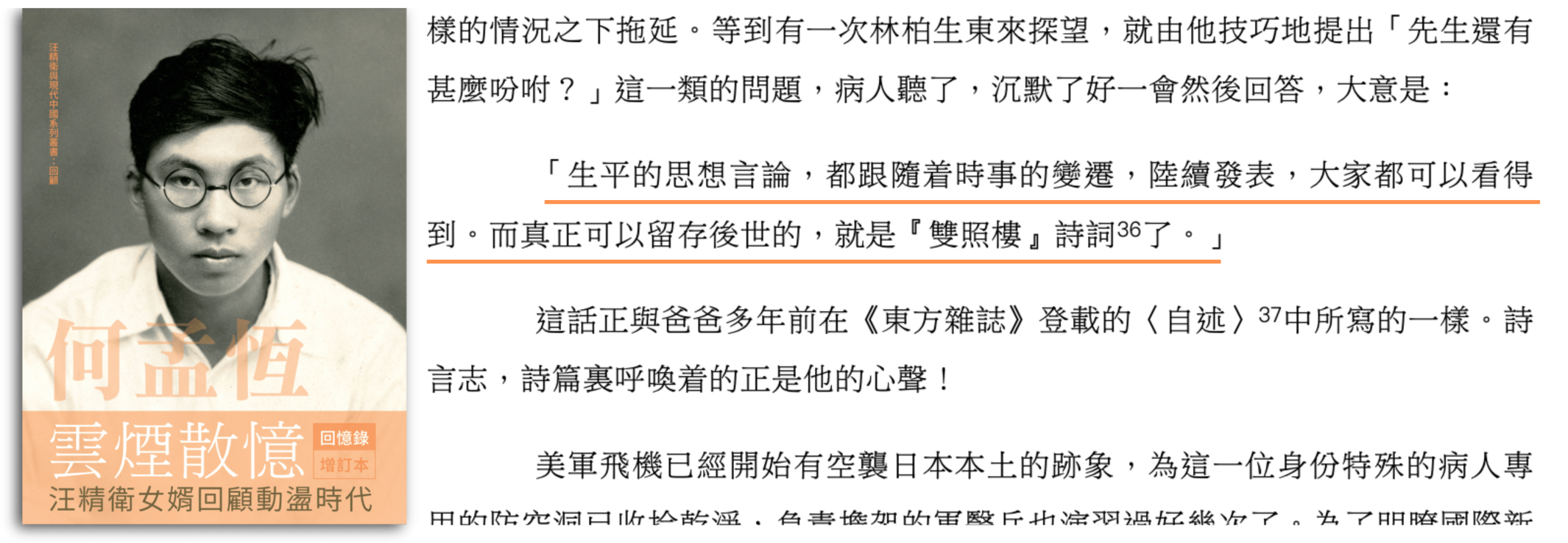
Photo 1: Cloud, Smoke, Scattered Memories — the Memoir of Ho Mang Hang (page 198) records Wang’s words from his sickbed to the head of the Propaganda Bureau Lin Baisheng
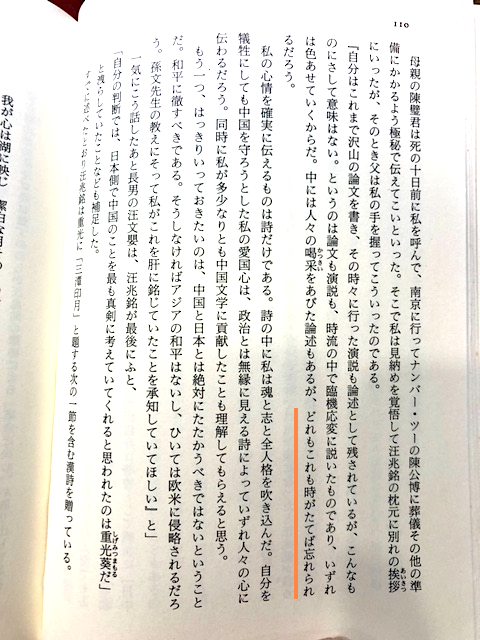
Photo 2: The words ”should be consigned to oblivion” do not appear in Fuyuko Kamisaka’s book (page 110). Instead, the original text reads: “they [essays and speeches] will all likely be forgotten in time.”
Neither book contains “should be consigned to oblivion” in words or meaning. There is also no record of any instructions from Wang Jingwei to descendants to not publish his own words. What Wang expressed might have been an objective judgment or a forecast, but there was no directive or wish. The author’s conjecture depends on the giving the original texts a different tone and meaning.
There is no record that indicates Wang Jingwei worried about his reputation or asked that his writings be forgotten. Instead, in the 1934 “Autobiographical Draft” Wang says: “My essays and speeches are the truest form of my life story.” (Wang Jingwei: His Life, Ideas & Beliefs, page 518) In 1939’s “One Example” (Wang Jingwei’ Political Discourse, pages 431-446), he writes: “Should I die, I hope my compatriots will re-read these lines and clearly understand that my policy is the road that will lead China to her salvation, and secure permanent peace in the Orient and in the world generally.” In “My Final Sentiments,” considered to be Wang Jingwei’s last will, there is a no mention of a wish that his political writings be “consigned to oblivion” after his death. (Wang Jingwei’ Political Discourse, pages 670-679.) In the 1988 published recollections of Ota Mototsugu who was charged with taking notes of the patient’s condition, Wang Jingwei’s last words did not contain the alleged “wish” or ”instruction.”
Neither members of the family nor followers went against Wang’s so-called “last wish.” They dedicated themselves to preserve and publish Wang’s poetry, essays and speeches which began soon after his death and continue to this day.

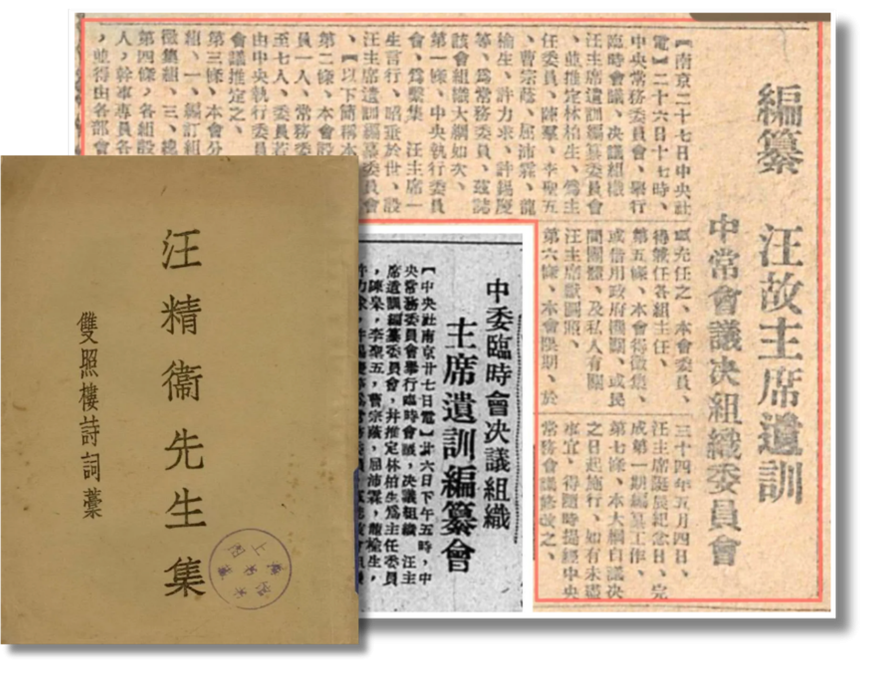
Photo 4: 15 days after Wang’s death, Lin Baisheng and others formed an editorial committee and announced their mission to publish all of Wang Jingwei’s writings and speeches. However, months after the first volume devoted to Wang’s poetry was published in 1945, these plans had to be abandoned due to the arrests and subsequent execution of Lin and other members of the committee.
—
The Book also contains factual errors. Using Zhou Fohai’s diary as a source, the author misattributes a conversation between Zhou Fohai and Luo Longji as a conversation between Zhou and Wang Jingwei, whose name was not mentioned at all in the diary entry on that date. She also describes Nagoya being shelled by the Allied Forces as Wang Jingwei lay in the hospital bed, when the Allied air raids over Nagoya did not begin in 1944 until December 13, more than a month after Wang Jingwei had died.
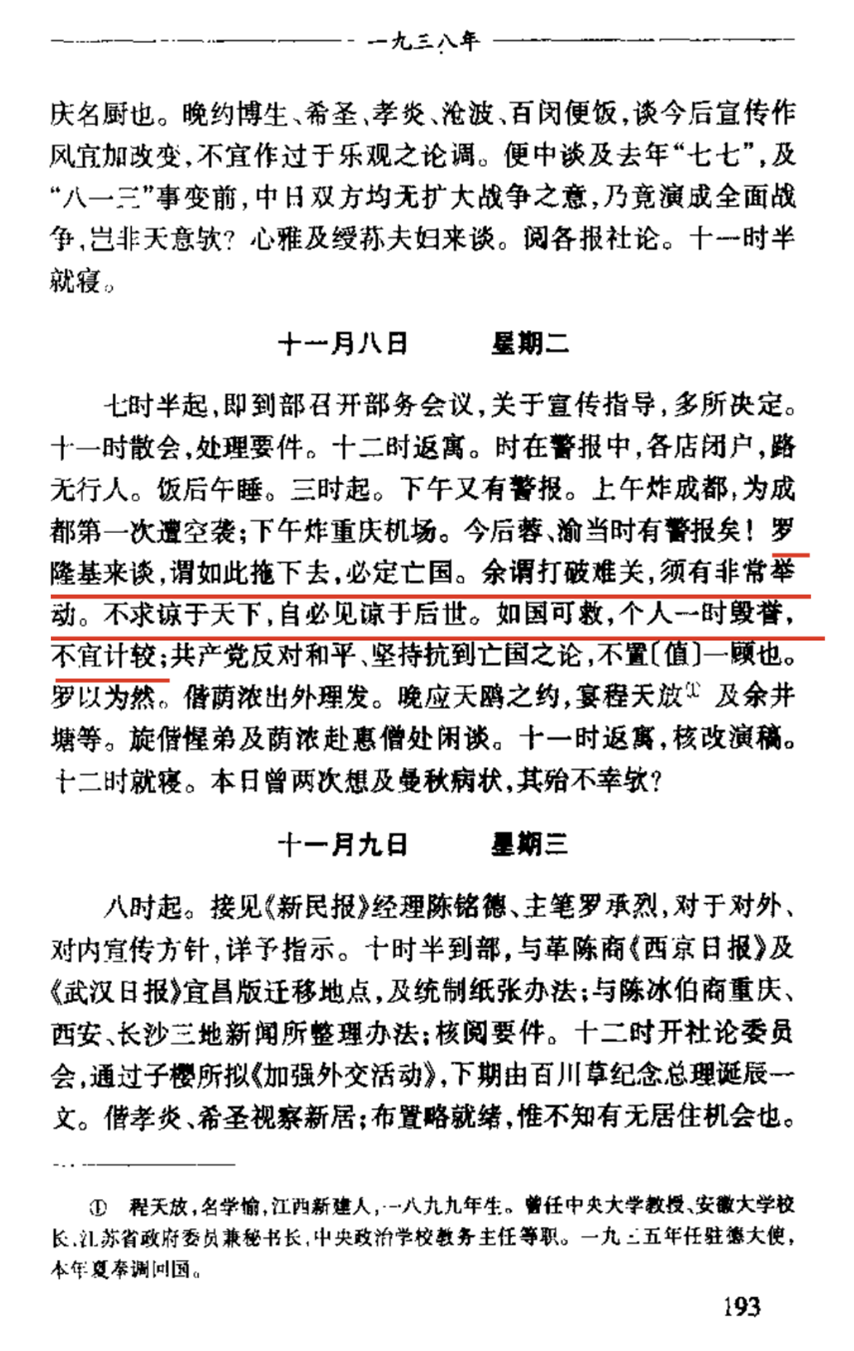
Photo 5: Zhou Fohai’s Diary cited by the Book (page 193)
The Book discounts and undermines eye witness accounts, including Wang Jingwei’s own descriptions. The author characterizes the Hanoi assassination as a “Rashomon” situation. Citing the writings of three authors Ho Mang Hang, Chan Cheong-choo, and Chen Gongshu as “different accounts,” the author ignores a key fact: Ho Hang Mang was the only eye witness. Chan Cheong-choo was in Shanghai and Chen Gongshu was in a car outside the building where the assassination took place. This undermines the authority of the true eye witness testimony, creating a “truth is hard to tell” situation.
The author also uses her predetermined theory to interpret Wang’s poem she entitles “Night Onboard,” imagining a scenario where Wang was “rescued” from a sunken ship in a storm during the journey out of Hanoi. Neither Wang Jingwei nor Chen Gongshu, who were both present during the journey, recall such a situation in their writings about the journey.
—
The Book theorizes that Wang Jingwei “intentionally” assigned two different dates for the creation of “Night Onboard” for political reasons — May 1939 for the Japanese and June 1939 for the Chinese, and asserts that her theory “speaks of the performative nature of Wang’s lyrical authenticity.” But this is chasing shadows. A click of the mouse reveals that Wang Jingwei indicated on no fewer than four calligraphy scrolls of “Night Onboard” that the poem was composed in July 1939. If, as the Book alleges, Wang Jingwei “intentionally” assigned the creation date as May or June for political reasons — then what “special implication(s)” does July signify? This is further evidence that the author chooses to ignore Wang Jingwei’s own writing to reach a predetermined conclusion.
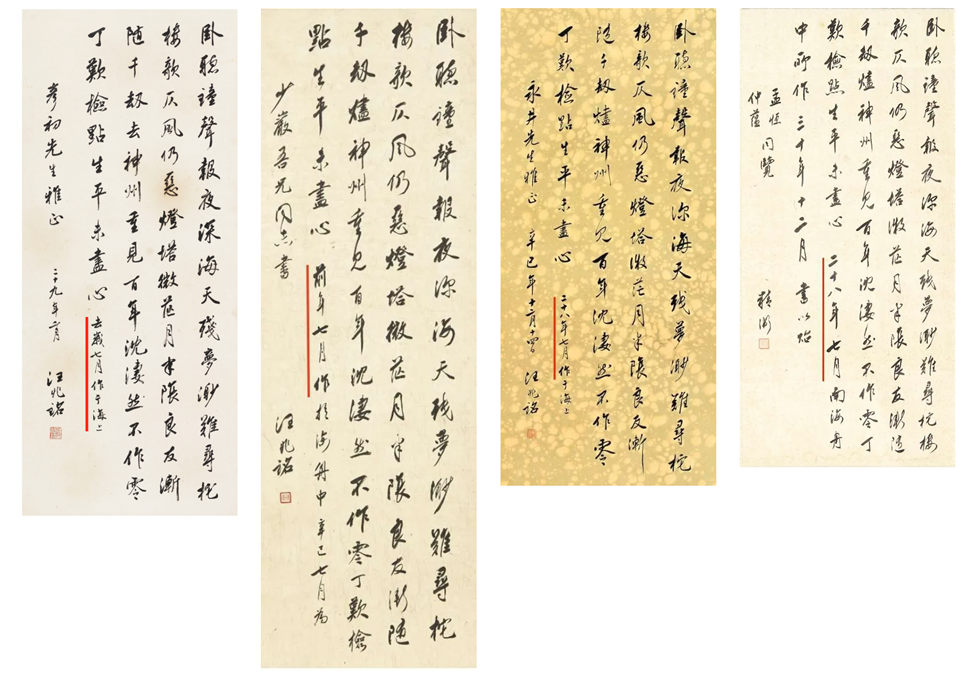
Photo 6: Four calligraphy scrolls by Wang Jingwei dedicated to Japanese as well as Chinese people, including family members, show that “Night Onboard” was created in July.
About the Wang regime’s Reorganized National Government (RNG), the Book asserts that it “was founded on pretense.” The author ignores the experiences of the 200 million occupants of the Japanese-conquered territories. She does not mention any research that depicts Wang and the RNG in a positive light. The author cites Iris Chang’s book The Rape of Nanking but neglects to mention that the Chang book focuses on the Nanjing Massacre, which took place before the RNG was established. The Rape of Nanking does not even mention Wang Jingwei’s name.
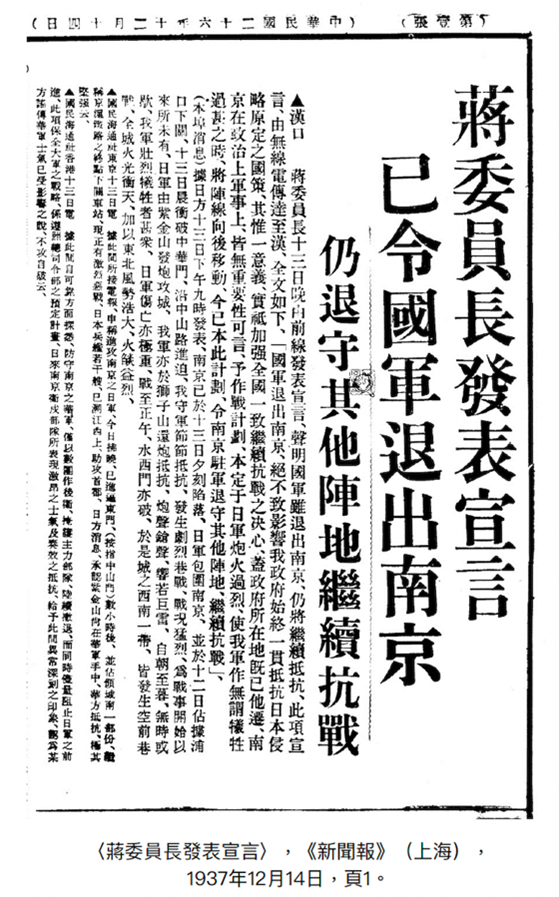
The Book describes Wang Jingwei and his RNG as “the collaborators who lost the city [Nanjing] to invaders and then came back to rule as Japanese puppets, their moral claim undermined by profound shame.” But Chiang Kai-shek was the head of the Chinese government and commander-in-chief, and it was he who put Tang Shengzhi (1889–1970) in charge of the Nanjing’s defense. (See December 14, 1937 news report on the right about Chiang’s order to retreat from Nanjing.) The author disregards Wang’s anger and sense of powerlessness over the “abandonment of the city before citizens were relocated first,” well documented in his own writings in Wang Jingwei Political Discourse and My Books, My Teacher: The Diary of Wang Wenxing.
As a publisher of Wang Jingwei’s essays, speeches and poetry, we are duty-bound to point out the Book’s most blatant problems by citing primary source material that has already been published for everyone to see. This article lists only a few examples of the Book’s problems. Regrettably, Yang has missed the opportunity to create the objective biography that she purports to write.
—
Postscript: The author’s undisclosed Confucius Institute affiliation is not mentioned, because this response addresses issues in the book, and is not a personal attack on the author.