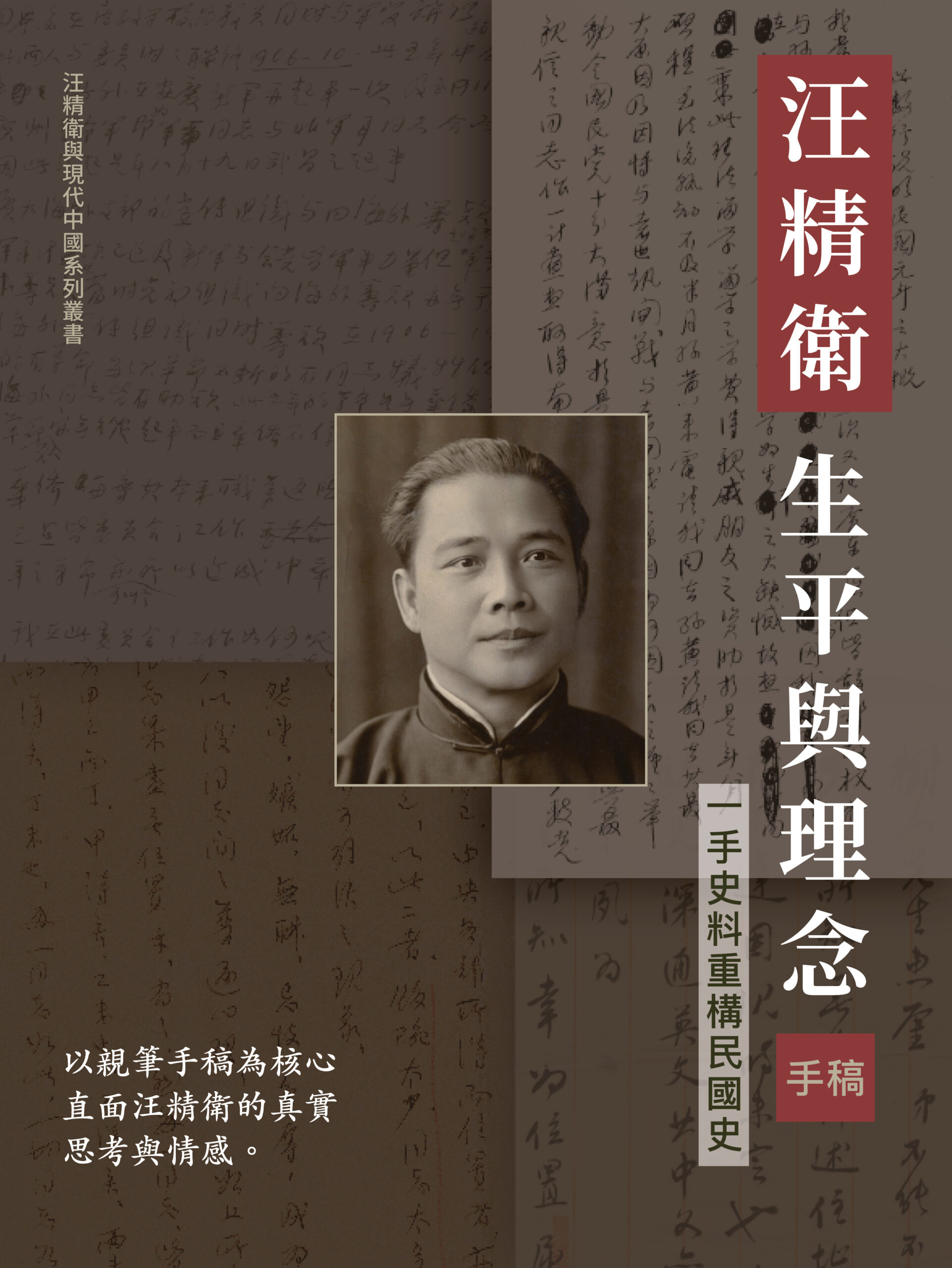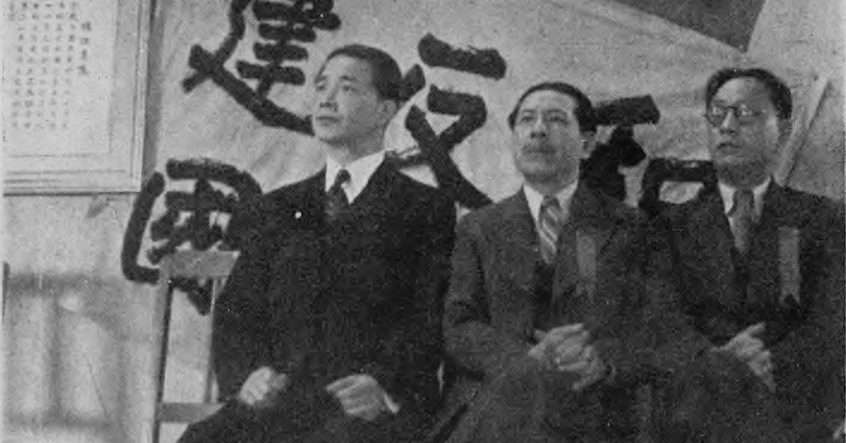
Zhou Fohai photographed with Wang Jingwei and Chen Gongbo. (Wikimedia Commons)
 A Chinese politician and second-in-command of Wang Jingwei’s Reorganized National Government (1940-1945), Zhou Fohai was a complex figure. Educated in Japan, credited as one of the founders of the Chinese Communist Party, Zhou quit the Communist Party in 1924 to join the Guomindang, maintained strong ties with the party’s leftist faction, headed by Wang Jingwei and Liao Zhongkai, then allied himself with Wang’s rival Chiang Kai-shek. Yet Zhou opposed Chiang’s Northern Expedition and Chiang’s actions during the Second Sino-Japanese War, which caused him to support Wang’s Peace Movement, and join Wang in the establishment of the Nanjing regime in 1940, where he served many roles and became a powerful figure after Wang’s death in 1944. But a last-minute bid at rapprochement with Chiang Kai-shek during the 1940s did not succeed; Zhou stood trial for treason, was sentenced to life imprisonment in 1947, and died in prison a few months later.
—
A native of Yuanling county, Hunan province, Zhou Fohai was the son of an official in the Qing Dynasty administration. Zhou was sent to Japan in 1917, where he attended the No. 7 Military Preparatory School (later known as Kagoshima University) and earned a degree in economics at Kyoto Imperial University in 1924.
While in Japan, Zhou developed an interested in Marxism and thus became one of the founding members of the Chinese Communist Party. In 1921, he attended the First National Congress of the Chinese Communist Party (CCP) in Shanghai as a representative of overseas students in Japan. After the emergence of the United Front, an uneasy relationship between the CCP and the Guomindang (GMD) formed in 1923. Zhou left the CCP in 1924 to join the Guomindang. At the invitation of Dai Jitao, Zhou served as a secretary of the Guomindang Propaganda Bureau and maintained ties with the leftist faction of the GMD headed by Wang Jingwei and Liao Zhongkai.
Zhou Fohai first met Wang Jingwei in 1924 while still a student, during the United Front (Communist Party-Guomindang) period. They were introduced by the secretary of the Guomindang Propaganda Department in Shanghai, Mao Zedong. Meeting Wang, who was considered a much-admired and charming revolutionary elder, left a strong impression on Zhou.
In 1926, during the Nanjing – Wuhan Split, Zhou became the head secretary of the Central Military and Political Science Academy (later renamed Whampoa Military Academy) under the Wuhan government led by Wang Jingwei. The following year, after the Nanjing government was formed, Zhou joined the Chiang Kai-shek faction and became Chiang’s trusted assistant. He was elected to the Central Executive Committee and served as head of the Guomindang Central Mass Training Bureau. By this time, Zhou had become the party’s leading anti-communist right-wing theorist with the publication of his book The Theoretical Framework of Sun Yat-sen’s Three People’s Principles (1928).
Chiang never treated me as a man of talent. Also, his peace versus war strategy was different from mine. Now, Mr Wang and I embrace the same ideas, and Mr Wang treats me as his equal. How could I leave him? On the issue of peace, I could never go against Wang.ZHOU FOHAI
After the outbreak of war with Japan in 1937, Zhou Fohai, Tao Xisheng, Gao Zongwu, Mei Siping and others formed the “Low-Key Club,” which evolved into Hankou’s Society for the Study of Art and Literature, to advocate for peace as a means to save the country. In the beginning of 1938, with Chiang Kai-shek’s agreement, Zhou sent Gao Zongwu to Japan to negotiate matters related to the Peace Movement. However, Chiang’s indecisiveness persuaded Zhou to change direction and support Wang Jingwei. Zhou traveled to Hanoi with Chen Gongbo and brought the December 29 Telegram to Hong Kong for Lin Baisheng to publish. In 1939, Zhou conducted peace negotiations with Japan in Shanghai along with Wang.
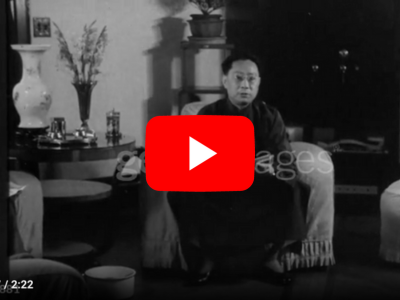
Zhou Fohai announces Central Reserve Bank notes
After the establishment of the Nanjing government in 1940, Zhou Fohai and Chen Gongbo became Wang Jingwei’s most important aides. But unlike Chen, Zhou was an originator of the Peace Movement and fully agreed with Wang Jingwei that it was better for China to undertake peace, not war. Although his official position was technically beneath that of Chen, Zhou was the driving force behind the Peace Movement and was, by all accounts, the most powerful person under Wang. At the founding stages of the Nanjing government, Wang assigned Zhou important responsibilities, trusting him to perform essential tasks such as drafting the core personnel list of the government body. Second in power only to Wang himself, Zhou developed a considerable personal following in the Nanjing government and wore many hats, serving as Deputy Chair of the Executive Yuan, head of the Department of Finance, head of the Central Reserve Bank, organizer of the tax police and Minister of Foreign Affairs. Zhou and Chen Gongbo remained good friends through this period and often discussed political matters late into the night. Yet despite his close association with Wang and Chen, Zhou gradually lost faith in the Peace Movement after the Second World War broke out in the Pacific and the United States entered the War. Zhou began making secret contact with Chiang Kai-shek in Chongqing through underground channels.
In 1943, when Zhou Fohai’s home in Nanjing was burned, Chen Bijun rushed to the scene to express her sympathy and brought Zhou and his wife to the house of Chu Minyi (located across the street from Wang Jingwei and Chen Bijun) for shelter. Wang Jingwei, who was holding a meeting with Japanese officials at the time, aborted the meeting and went to Chu’s house to assess the situation. Zhou was grateful for the expressions of concern.
Even though Zhou wrote in his diary about his displeasure over Wang’s character [as “letting other people be the bad guy while benefitting himself,” being “quick tempered” and “easily influenced by his wife”], Wang trusted Zhou, because Wang felt they agreed with one another on the issue of the Peace Movement. Zhou was also grateful to Wang, as revealed in an entry in his diary, in which Zhou described his relationship with Wang: “I live and die with Mr. Wang. We experience difficulties together. Whether over politics, ethics or matters of justice, I could never go against Wang. This is different from my relationship with Chiang before I left Chongqing. Chiang never treated me as a man of talent. Also, his peace versus war strategy was different from mine. Now, Mr. Wang and I embrace the same ideas, and Mr. Wang treats me as his equal. How could I leave him? On the issue of peace, I could never go against Wang.”
We believed in peace as a means to save the country. Therefore, we consider ourselves to be national heroes. …If we die as national heroes, then peace between China and Japan can be secured. If we die as traitors, the Sino Japanese dispute can never be resolved.ZHOU FOHAI
In early 1944, when Zhou learned that Wang had a tumor in his vertebrae, he met with Chen Gongbo and Mei Siping and discussed the matter for six or seven hours. Zhou regretted that Wang, after working so hard his entire life, would not live to see the unification of China. In August 1944, he travelled to Nagoya to visit Wang. Upon seeing Wang’s physical weakness, Zhou was full of tears. On the day of Wang’s funeral, even though Zhou was suffering from malaria, he managed to attend the funeral and view the body with reverence.
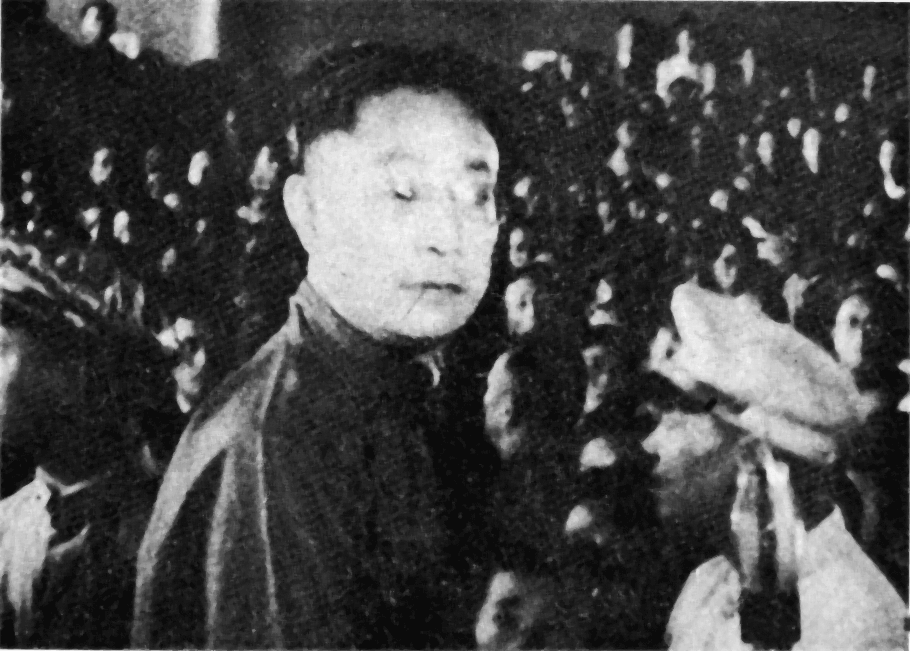
Zhou Fohai on trial
Even though Chen Gongbo had succeeded Wang as head of the Nanjing regime after Wang’s death, Chen’s influence was often upstaged by Zhou, who succeeded Chen as the mayor of Shanghai but was also viewed as a true believer in the Peace Movement and the last living architect of Wang’s Nanjing regime. At the end of the War, Zhou briefly fled to Japan, but was returned to China for trial. He was sentenced to death as a hanjian (traitor to China) but this was commuted to life imprisonment by Chiang Kai-shek in 1947 after Zhou’s wife interceded on his behalf. Zhou fell ill while in prison and died on February 28, 1948 at the age of 50.
In a speech to Japanese officials, Zhou Fohai said the following:
The people in Chongqing consider themselves to be national heroes and us traitors. Yet, we also consider ourselves to be national heroes. But national heroes or not must be decided on the ability to save the country. We believed in peace as a means to save the country. Therefore, we consider ourselves to be national heroes. But whether we die as national heroes or traitors must also depend on our ability to save the country. If we die as national heroes, then peace between China and Japan can be secured. If we die as traitors, the Sino-Japanese dispute can never be resolved.
Zhou Fohai explained well that whether supporting war or peaceful negotiation, China’s politicians at that time were deeply influenced by nationalistic ideology. Whether they should be considered traitors or heroes can only be decided by [the development of history?... no] future historians. There is no definitive answer.
References
Zhou Fohai. Wangyiji (Recollections of the Bygones), Shanghai shudian, 1989
Zhou Fohai. Zhou Fohai riji (Diary of Zhou Fohai), two volumes, Beijing: Zhongguo shehui kexue chuanshe, 1986
Zhang Jiangcai. Wang Jingwei xiansheng xingshilu (Factual Accounts of Mr. Wang Jingwei), Zhonhua minguo shiliao biankan hui, 1943
now available as individual e-books and in print