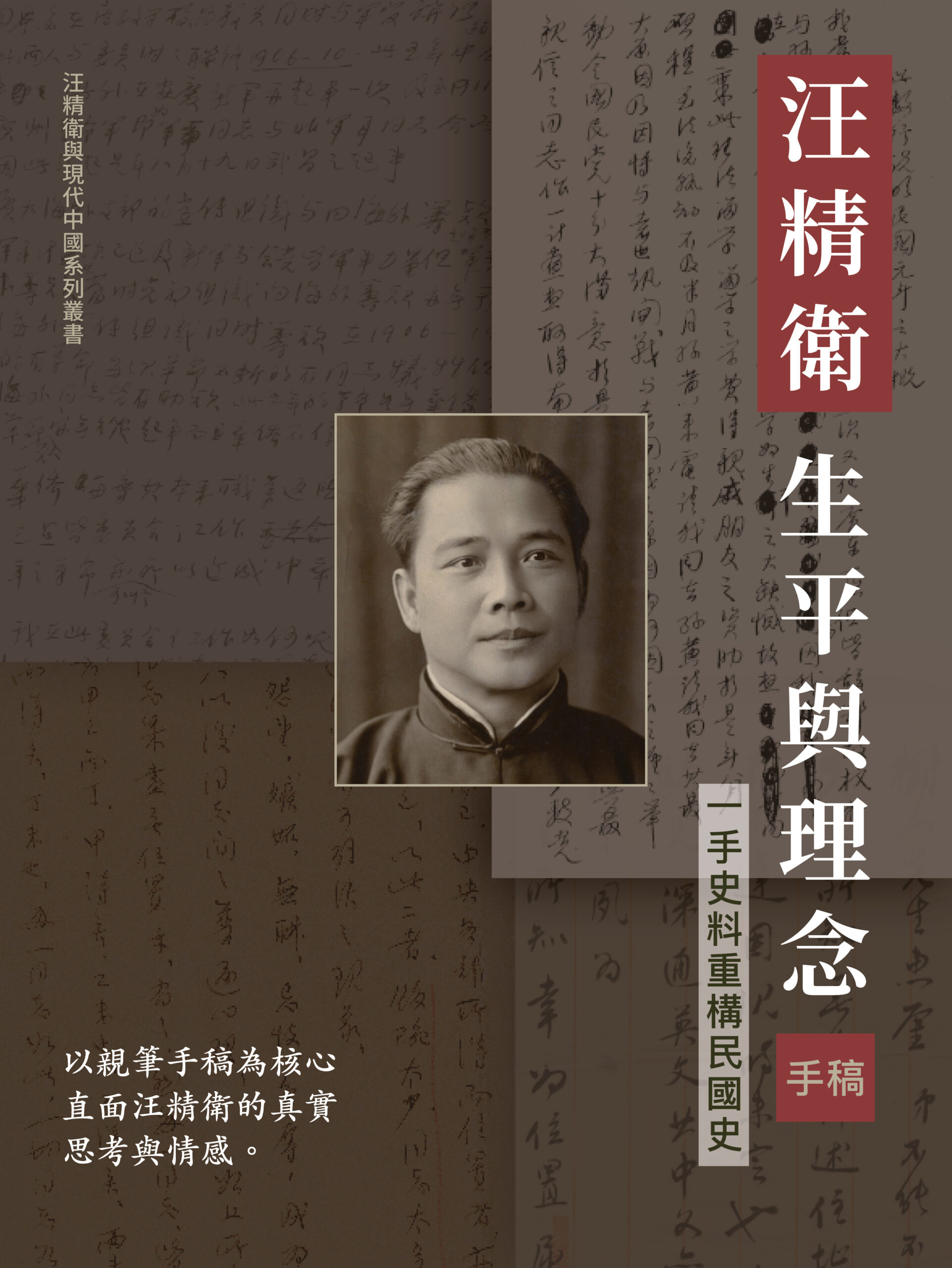
China Times Publishing and the Wang Jingwei Irrevocable Trust held a book launch seminar on December 14, 2025 for the paperback edition of Wang Jingwei: His Life, Ideas and Beliefs—Reconstructing the History of Republican China with Firsthand Materials. Hosted by China Times Chair and President Chao Cheng-ming, the event was attended by many special guests, including Professor Eugene Chiu of Tonghai University, Associate Professor Hsu Yuming of Dong Hwa University, and the 97 year-old opera singer Chen Yuang-Zheng, who led the seminar by sharing his experiences growing up under the Wang Jingwei Regime.
In his presentation, Professor Chiu highlighted the contributions of Ho Mang Hang for organizing the historical material, which requires interpretation to give it life:
Archival material in itself is not history, it is only a source. Only with interpretation in connection with the era does it become meaningful.
Without this material, without Ho Mang Hang’s organization, we would need to start from scratch with authentication and organization, which is a huge endeavor.EUGENE CHIU
As for how the label hanjian came about, Professor Chiu suggested another point of view. During the time of the May Fourth Movement, “traitor” was a more frequently used term, while hanjian became a prominent political label later. It was Mao Zedong who first called Wang Jingwei a hanjian: the term did not develop from within the Kuomintang.
•
Professor Hsu summarized the editorial methodology of Wang Jingwei: His Life, Ideas and Beliefs — Reconstructing the History of Republican China with Firsthand Materials as follows: source collection leads to understanding and understanding precedes evaluation and criticism.
He described the editorial approach as rigorous and restrained, not jumping to tell the reader whether Wang Jingwei was right or wrong, hero or sinner. Rather it presents the primary sources and allows the reader to delve into the material, to understand the situations before offering a judgment. In other words, one of the most important contributions of the books, Professor Hsu said, is to “return the right of evaluation to the readers.”
We recommend this book, because it does not give the readers a quick answer but takes a step back and poses an essential historical question: How did Wang Jingwei arrive at his decisions gradually? If we cannot ask this question, we are not truly facing history, we are simply repeating a predetermined judgment.HSU YUMING
What makes Wang Jingwei difficult to evaluate in simple terms is that he was not facing abstract moral decisions, but a difficult trade-off between war, the existential threat to the nation and the realities of politics. Professor Hsu raised this question at the seminar:
How would you choose? Would you prefer to hold your ground to the very end, or seek a compromise? Would you choose ideals or reality?
This is also the true challenge this book leaves its readers.
•
During the question and answer session, National Chi Nan University History Professor Ying-hui Lee shared an unusual account from a descendant of someone who lived in the occupied Shanghai under Wang Jingwei. In conclusion, Professor Lee reminded us:
We should not view everything through preconceived notions.
•
Wang Jingwei: His Life, Ideas and Beliefs does not ask readers to change their point of view, it asks them to first return to the source. When Wang’s autobiographical draft, letters, poetry, political writings are put together with the recollections of eye witnesses, Wang Jingwei is no longer a mere label in history books, but a person who must be returned to a renewed understanding in history.
We thank China Times for recording the seminar and validating the importance of this book through its republication.
We hope this book will be passed down. Opinions on Wang Jingwei vary—some regard him as a great figure, others as a sinner—and discussions regarding the history of the Republic of China are relatively scarce in the current climate in Taiwan. Yet, as a piece of history centered on a pivotal figure who shaped the story of the Republic of China, I believe this book is worthy of being read and savored with care and passed down to future generations.CHAO CHENG-MING