

The six-volume Wang Jingwei & Modern China hardcover series (the first edition) was launched in 2019, featuring a trove of first-ever-published handwritten manuscripts by Wang Jingwei and his associates. In response to enthusiastic global response, the Wang Jingwei Irrevocable Trust followed up with individual paperback editions and e-books. While preserving the original content, the new editions include additional primary source material. We also added new titles to enhance our understanding of Wang Jingwei and his role in modern Chinese history by offering more content in the new editions.
Added content in the NEW paperbacks and ebooks
 Wang Jingwei’s Political Discourse: Selected Essays, Speeches, Letters and Telegrams—The Newly Compiled and Revised Edition
The writings in the 2019 first edition of Wang Jingwei's Political Discourse were transcribed from the fifteen volumes of Wang’s works gifted by Fang Junbi to Ho Mang Hang. After publication, the Trust continued to examine the same writings published contemporaneously elsewhere and discovered inconsistencies among different documents, newspapers, and manuscripts, likely due to political, war-related, or editorial reasons at the time. For each of the 121 articles in the current three-volume paperback edition of Wang Jingwei’s Political Discourse: Selected Essays, Speeches Letters and Telegrams —The Newly Compiled and Revised Edition, our editors cross-referenced three or more published versions which are difficult for today’s readers to access. Inconsistencies, ambiguities and corrections have been resolved and annotated with cited sources, allowing the readers to read Wang’s words as close to his original intentions as possible.
The paperback edition is available in a three-volume set, while all three volumes are combined in a single e-book.
 Wang Jingwei’s Poetry: Unabridged Edition with Calligraphy and Annotations, Volumes I & II
Volume I of the newly expanded version of Wang Jingwei's Poetry replaces the scans of each page from Shuangzhaolou shicigao that Wang’s eldest son Wenying (1913-2011) had printed in Hong Kong by Wingtai Printing Company 永泰印務公司 in the 1950s with full transcriptions of each poem. These transcriptions are cross-referenced against Xiaoxiuji published by Zeng Zhongming in 1940, the 1945 edition published by the Wang Chairman’s Legacy Instruction Compilation Editorial Committee 汪主席遺訓編纂委員會, and the 2004 reprint by Wang’s youngest son Wenti (1925-2024). When inconsistencies appear among these publications, we rely on Wang’s handwritten manuscripts for definitive resolution. This makes Volume I the most definitive poetry publication reflecting Wang’s true intentions.
Volume II builds upon the more than 100 pages of manuscripts from the 2019 edition, with more than 200 additional pages of Wang Jingwei’s calligraphic works preserved by family members, which offer further insight into his creative process.
Wang Jingwei's Poetry: Unabridged Edition with Calligraphy and Annotations, Volume I is sold as a standalone paperback book. Hardcover editions of Volumes I & II are sold together as a single set. E-books are also available in two volumes, which can be purchased separately.
 Wang Jingwei Nanshe Poetry— Newly Compiled and Revised Edition
The goal of the 2019 first edition of Wang Jingwei’s Nanshe Poetry was to publish Wang’s complete never-before-seen handwritten manuscript with full transcriptions of the 37 most recognized articles. The recently published Wang Jingwei Nanshe Poetry — Newly Compiled and Revised Edition includes transcriptions of 16 additional articles from newspapers at the time — The Chung Hwa Times, Social Daily, and Ancient and Modern Biweekly, totaling 53 articles. This new volume provides readers with the most complete Nanshe Poetry organized according to literary and historical contexts.
Available in paperback and e-book.
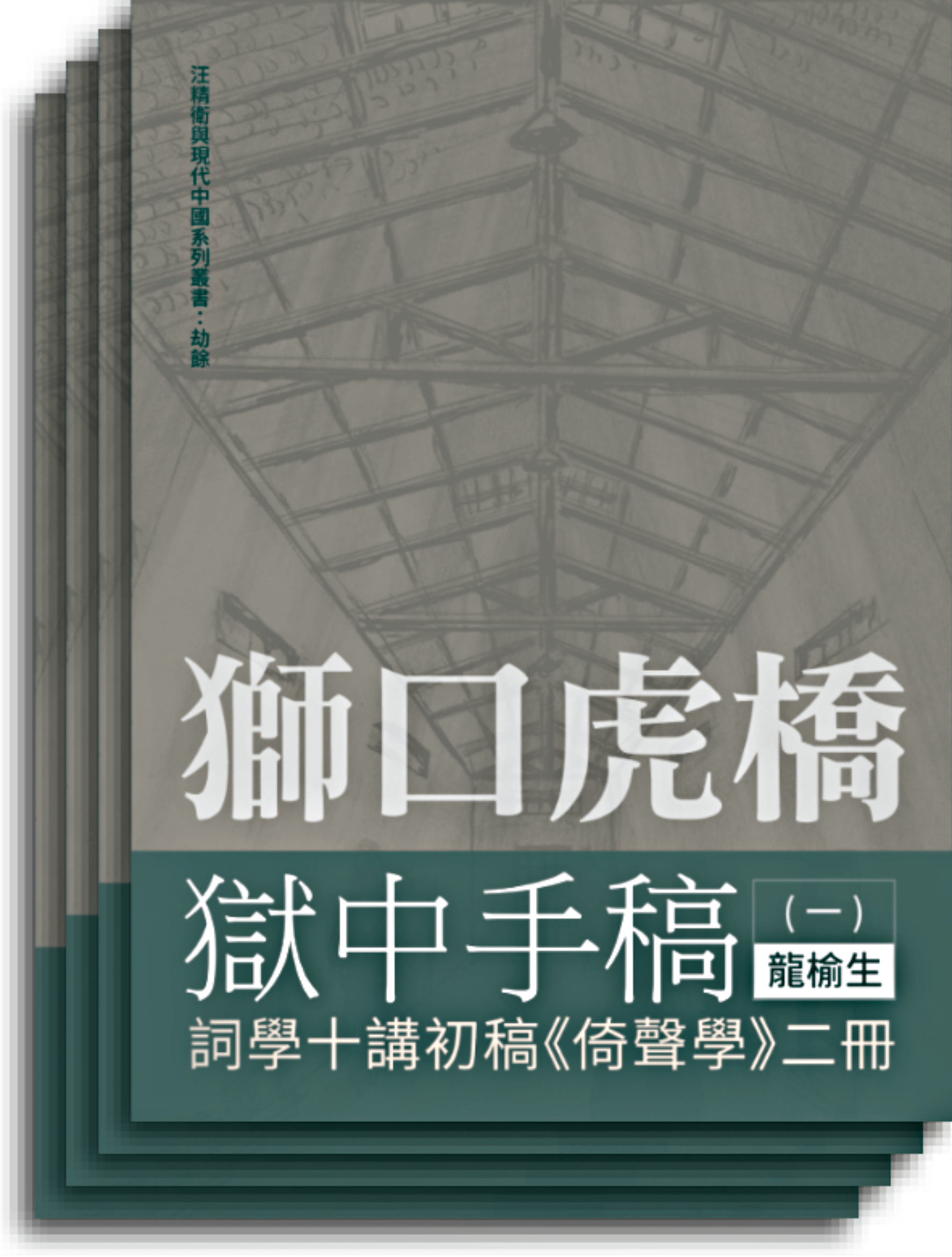 Prison Writings by Members of the Wang Jingwei Regime, Volumes I-IV
The 2019 first edition of Prison Writings by Members of the Wang Jingwei Regime presents handwritten prison writings collected by Ho Mang Hang upon his release from Nanjing Tiger Bridge Prison in March 1948, offering a rare post-war record of the Wang regime and furthering our understanding of Republican history. The expanded 2024 four-volume set Prison Writings by Members of the Wang Jingwei Regime features additional material including unpublished handwritten manuscripts from the poetry collections of Zhou Zuoren and Wei Nailun. Every page of the five books of Chen Bijun’s hand-copied “Shuangzhaolou” poetry is included in the revised edition, offering a unique look at Wang Jingwei’s poetry through his wife. More detailed biographical backgrounds of the creators of these prison writings are also added, including a biographical sketch of Chen Bijun.
The four-volume paperback edition is sold as a single set. The e-book edition is reproduced in full color and available in four volumes, which can be purchased separately.
 Cloud, Smoke, Scattered Memories: The Memoir of Ho Mang Hang
The expanded edition of Cloud, Smoke, Scattered Memories, the Memoir of Ho Mang Hang builds on the 2019 first edition with additional images totaling approximately 400 paintings, photographs, letters and other documents. Additional writings by Ho Mang Hang are included in the miscellaneous section, and Ho’s notes after reading Zhang Jingxing’s biography of Chen Bijun are added to the appendix. The new edition also includes illustrated sidebars to provide historical backgrounds to events the author describes in his memoir.
The printed paperback features full-color paintings. The e-book edition is reproduced in full color.
•
New titles

My Books, My Teacher: The Diary of Wang Wenxing
Published in April 2024, this latest addition to the series provides a new perspective on Wang Jingwei in the form of a diary written by Wang’s eldest daughter Wenxing (1914-2015) during 1937-1938 at the outbreak of the Sino-Japanese War. The diary covers the critical period of Wang’s return to China after the Xi’an Incident until the release of the “October 28 Telegram.” Written as a home-school assignment with Wang Jingwei serving as Wenxing’s teacher, the diary features annotations by Wang Jingwei, showing in-depth discussions between father and daughter about the nation’s fate. In various sections of the diary, Wenxing's reactions to the Japanese invasion, Chiang Kai-shek’s response and the suffering of the Chinese people appear to influence Wang’s own thinking at the time. The book features dozens of previously unpublished family photographs. The appendix includes newspaper articles related to the events mentioned in the diary, making the book also an invaluable historical record of an important period in modern Chinese history.
Available in paperback and as an e-book.
 What Have I Done in My Life?
This collection of 365 quotations provides an ideal entry point into Wang’s ideals and values and represents the essence of his personality and political thought. Although many of Wang Jingwei’s writings were written nearly a century ago, his thoughts about all aspects of life — government and people, nations and nationalities, war and peace, revolution and sacrifice, philosophy and culture, love and virtue — offer practical inspiration for modern readers. Wang's most famous quotations are timeless, recited by millions of Chinese people from all walks of life today. This collection is suitable for readers who want to quickly familiarize themselves to Wang Jingwei’s thoughts and also serves as a convenient reference for those who need an appropriate phrase when during speech-making or teaching.
Available in paperback and e-book.
 1937: A War Begins
Graham Peck’s final six chapters of Through China’s Wall, beautifully translated into Chinese by Ho Mang Hang, provides a unique eye-witness account of the events surrounding the Marco Polo Bridge Incident in 1937, which led to the outbreak of the Sino-Japanese War, and served as a turning point in Wang’s political career. Peck’s unsparing account of people’s lives as an outsider deepens our understanding of the Sino-Japanese War, offering useful context for events that that impact the Asia Pacific region today. This first translation of Peck’s Through China’s Wall opens with a preface by Professor Eugene Chiu of Tunghai University.
Available in e-book.