In commemoration of her grandfather, Chief Editor of the Wang Jingwei & Modern China series Cindy Ho follows Wang’s final footsteps to Japan. Here, we share with our readers how Wang is remembered in Japan.
In March 1944, Wang Jingwei entered Nagoya Imperial Hospital under the code name of “plum” where passed away on November 10 from multiple myeloma. Details of Wang Jingwei’s last days are captured in Chapter 16 “Fallen Star” in Cloud, Smoke, Scattered Memories — the Memoir of Ho Mang Hang.
As a gesture of gratitude, Wang’s wife Chen Bijun gifted three plum trees to the hospital. These were originally planted in front of the hospital with a commemorative plaque, until the building needed to be torn down to make way for a new construction. Two of the three trees survived, which were then transported for safekeeping to the front of the south wing of the Nagoya University’s School of Health Sciences on the Daiko campus, where they stand today. A new plaque was erected in 2021-2022, bearing the same dedication. The Daiko Foundation continues to maintain the plum trees, which will be moved back to their original location, according to university officials.

Location of the plum trees on the Daiko Medical Center campus. The white plaque has now been replaced by a black one.


In January 1946, it was reported that on Chiang Kai-shek’s order, He Yingqin, Ma Chaojun, Ma Chongliu and Zhang Zhen and others planned to bomb of Wang Jingwei’s tomb on Nanjing’s Plum Blossom Mount which took place on January 21. When the tomb opened, a piece of paper about three inches long was said to have been found inside Wang’s robe, bearing the brush-written words “May the spirit of the dead return,” signed by Chen Bijun. In the end, the body and coffin were cremated.
•
Forty-two years later, a Japanese person erected a tombstone in Koenjiminami, Suginami City, Tokyo. The epitaph reads:
Mr. Wang Zhaoming, courtesy name Jingwei, was born on May 4, 1883 in Guangdong Panyu. Determined to “destroy the Han to prosper the Han,”, Wang studied in Japan and joined the Tongmenghui. After being arrested for a failed assassination attempt, his sentence was reduced by the Qing government. He was released after the Xinhai Revolution, and became a pillar of the Republic of China, devoting himself to affairs of the state. When the China Incident broke out, he considered the future of East Asia and advocated for Sun Yatsen’s support of Sino-Japanese coexistence and co-prosperity. Breaking from Chiang Kai-shek, he worked to build a government in Nanjing. Wang died on November 10, 1944, at age 62. Buried on Nanjing Plum Blossom Mount, his tomb was bombed and remains were discarded. So I decided to build a tomb here with the remains from the original burial grounds.A JAPANESE
notes
- The phrase “destroy the Han to prosper the Han” borrows from the slogan “destroy the Manchu to prosper the Han” of the Taiping Heavenly Kingdom—the theocratic monarchy which sought to overthrow the Qing dynasty—may have been carved in error, or some believe it suggests Wang’s greatest enemy was, in fact, the Han, or what it has come to represent.
- The China Incident refers to the official Japanese designation of the Sino-Japanese War which broke out in July 1937.


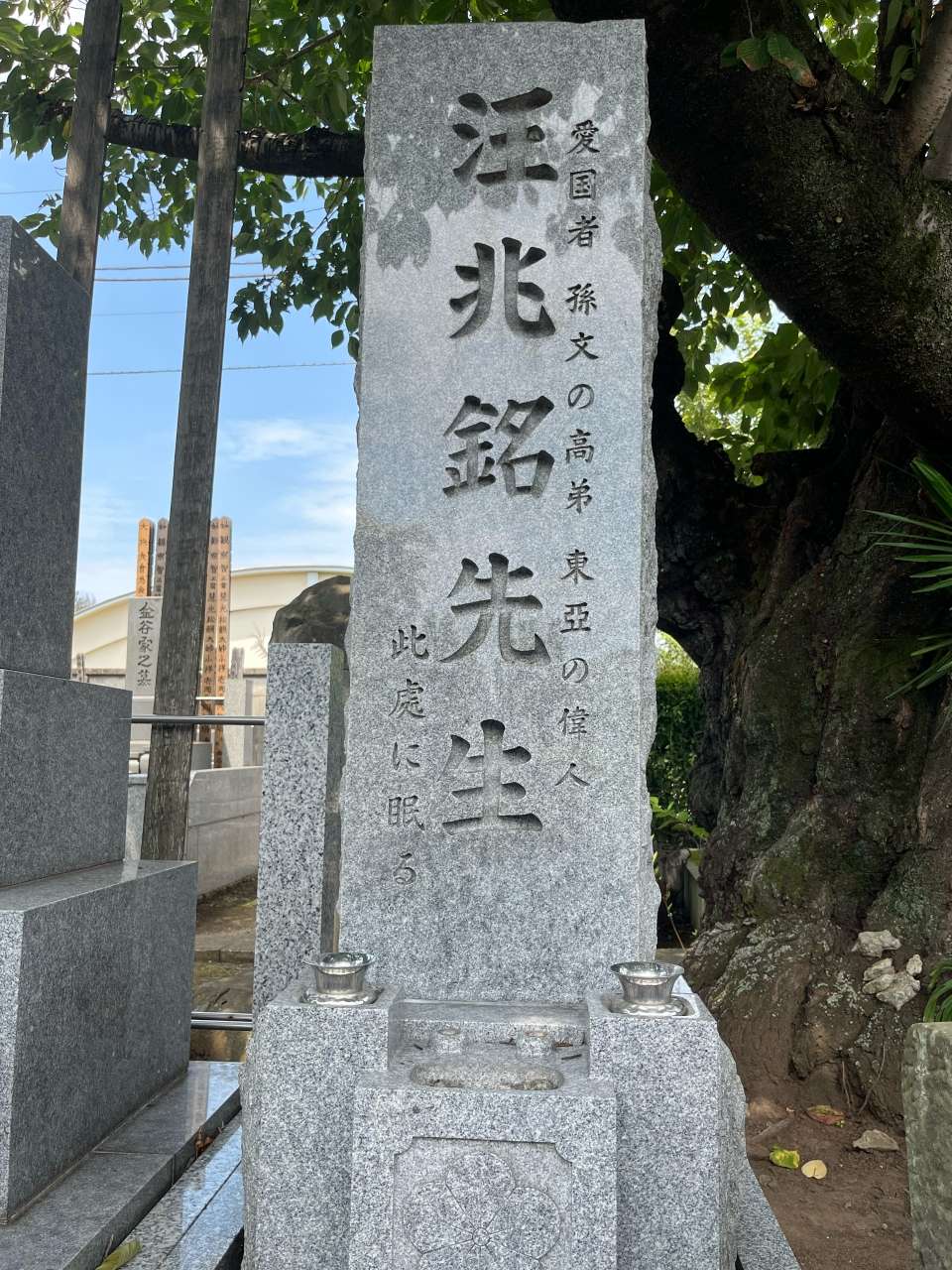
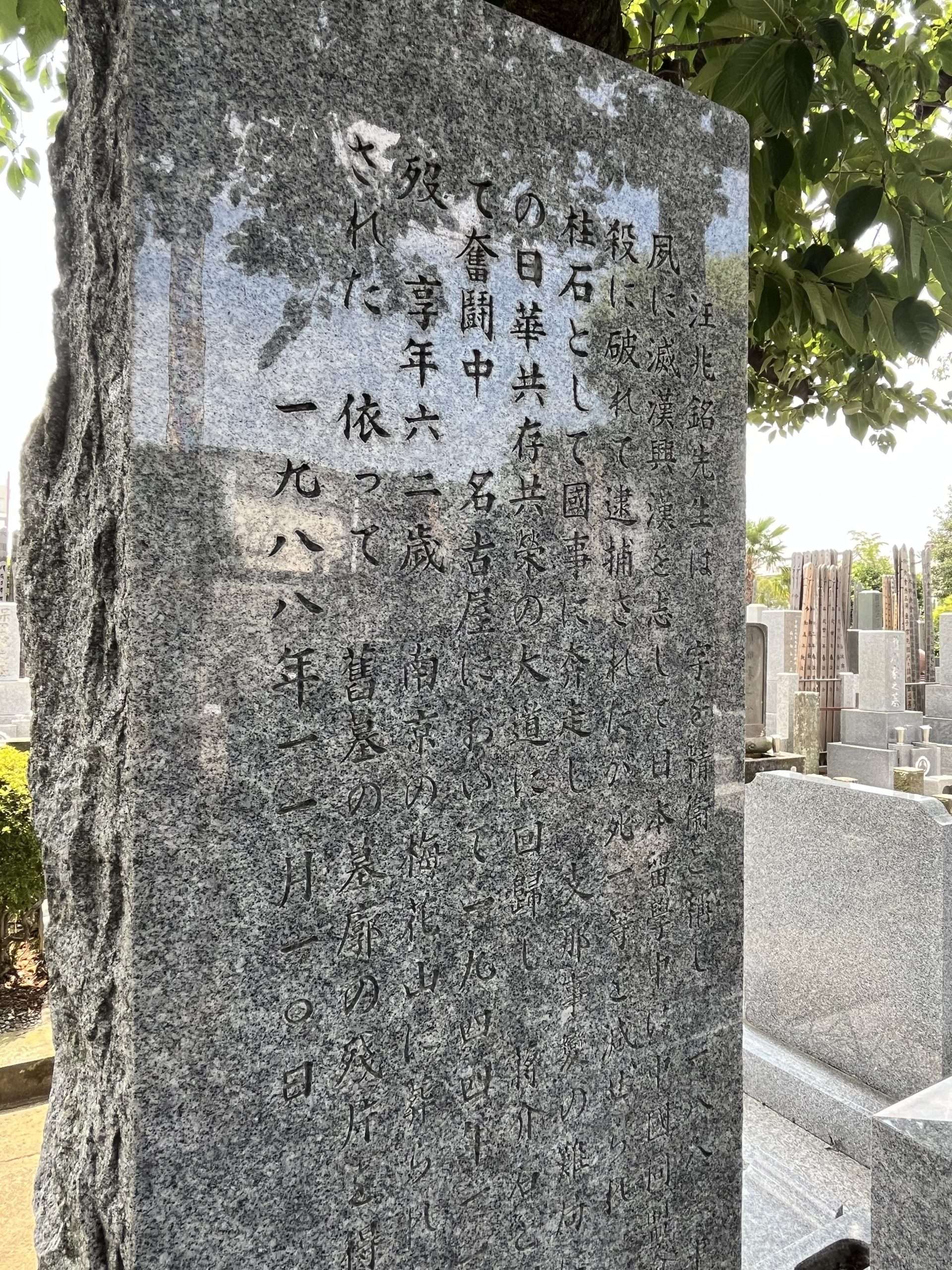
Inscription on the front of the tombstone reads: “Here lies Patriot, disciple of Sunwen (Sun Yatsen), great man of East Asia.” Because of the words “here lies” some mistakenly think Wang Jingwei’s body was buried here, but it fact, only ruins from the Plum Blossom Mount in Nanjing lie here. Photos: Cindy Ho.
now available as individual e-books and in print