Che Gongbo in Japan (Wikimedia Commons)
 A Chinese politician with an extensive resumé both in and outside of government, Chen Gongbo was a founding member of the Chinese Communist Party, and left the CCP to join the leftist faction of the Guomindang and became a close associate of Wang Jingwei and a vocal critic of Chiang Kai-shek from the mid-1920s onward. Even though Chen did not agree with the Peace Movement and opposed the Sino-Japanese Basic Relations Treaty, Wang’s separation from the Guomindang and establishment of the Nanjing Nationalist Government, Chen remained with Wang for both pragmatic and personal reasons. In 1940, after Wang formed the Nanjing Government, Chen served as the president of the Legislative Yuan, the Mayor of Shanghai, and the member of the Guomindang Central Executive Committee. After Wang’s death in Japan in 1944, Chen became the second and final premier and chairman of the Nationalist Government. In 1946, he was declared a hanjian (traitor to China), tried and sentenced to execution by firing squad.
—
A native of Nanhai, Guangdong, Chen Gongbo was steeped in revolutionary activities from a very early age. The only son of a provincial military commander of Guangxi who left office to support the overthrow of the Qing regime in Guangdong province, Chen managed to continue his studies and support the family after his father’s arrest and imprisonment in 1906.
After the success of the Xinhai Revolution and the fall of the Qing administration in 1911, Chen served as head of the Ruyuan County Council and enrolled in the prestigious Beijing University in 1917. After graduation in 1920, Chen returned to Guangzhou and founded the journal Guangdong Qunbao (Guangdong Masses) and the Guangzhou Socialist Youth Corps with Chen Duxiu, Tan Pingshan and others.
In 1921, Chen attended the first National Congress of the Chinese Communist Party (CCP) in Shanghai, but the many arguments that ensued during the meeting caused Chen to depart before the Congress had concluded. The following year, Chen found himself criticized by the CCP leadership for not sufficiently opposing Chen Jiongming’s attempted coup d’etat of Sun Yat-sen’s Guangzhou regime, whom the Communists had favored. Angered by the CCP’s accusations, Chen quit the Party and set sail for the United States, where he received a master’s degree in economics from Columbia University in New York City in 1924. The following year, at the invitation of Liao Zhongkai, Chen returned to Guangzhou to serve as head of the Guangdong Peasant and Worker Department and chief of the political department of the Guangdong Military Affairs Commission. From that point onward, Chen Gongbo came to know Wang Jingwei well.
After Liao Zhongkai was assassinated in August 1925, amid the power struggle that ensued following the death of Sun Yat-sen a few months earlier, Chen Gongbo managed to succeed Liao as chief of the Peasant Department of the Central Committee of Guomindang, also served on the Guomindang Central Executive Committee, and later assumed the role as director of the Political Affairs of the Revolutionary Army of the Northern Expedition.
We should be less emotional and evaluate calmly about what really happened: upon Mr. Wang’s arrival in Nanjing, with more than ten provinces already fallen into the hand of the Japanese, there was basically no “nation” for him to betray.CHEN GONGBO
During the Nanjing – Wuhan Split, Chen supported Wang and the establishment of the Wuhan Nationalist Government. After Wang stepped down from office and went to Europe in 1928, Chen founded the journal Geming Pinglun (Revolutionary Critique) which criticized Chiang Kai-shek’s Nanjing Government, and also founded Mainland University in 1928 in Shanghai. At the end of 1928, Chen formed, along with Gu Mengyu and others, the Guomindang Reorganizational Comrades Association to advocate following the principles set by Sun Yat-sen for reorganizing the party. In 1929-30, Chen helped Wang Jingwei, Yen Xishan, and Feng Yuxiang in their efforts against Chiang Kai-shek and held the Expanded Nationalist Party Conference in Beijing. But after failing to topple Chiang, Chen disbanded the Reorganizational Comrades Association in 1930 upon Wang’s instruction and went to Europe for a short time.
After the Manchurian Incident of 1931, there was a period when Wang and Chiang worked together. Wang (as Foreign Minister and Premier) served alongside Chen (as Minister of Industry). In 1935, after Wang had been shot and traveled to Europe to recuperate, Chen left his governmental post but could not stay away for long. In 1938, he returned to government service as chairman of Guomindang’s Sichuan branch.
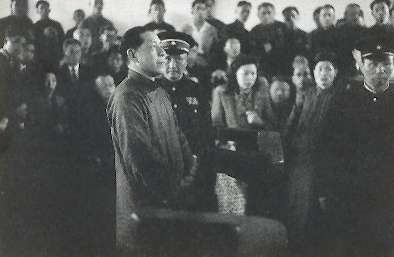
Chen Gongbo in the court room
When Wang released Yandian (the “December 29 Telegram”) in Hanoi, Chen Gongbo found himself in a quandary. Even though he opposed Wang’s separation from the Guomindang, as well as the Sino-Japanese Basic Relations Treaty that Wang had negotiated and Wang’s establishment of the Nanjing Nationalist Government, Chen decided to stay with Wang for reasons that were both personal and pragmatic. In 1940, after the Nanjing Nationalist Government had been formed, Chen served as the president of the Legislative Yuan, the Mayor of Shanghai, and as a member of the Guomindang Central Executive Committee. After Wang’s death in Japan in 1944, Chen became the second and final premier and chairman of the Nanjing Nationalist Government. In 1946, he was declared a hanjian, tried and sentenced to execution by firing squad.
Wang thought that his proposal spoke for those Chinese who wanted to speak but were afraid to do so. No one had dared to speak but Wang.CHEN GONGBO
The friendship between Chen Gongbo and Wang Jingwei ran deep. Chen had said that he only had two friends within the Guomindang: Liao Zhongkai and Wang Jingwei. He did not agree with the Peace Movement or the establishment of another Nationalist Government, but in supporting Wang, he believed that as long as his heart was at peace, he did not care about the potential destruction to his reputation and future.
As Chen reminisced from jail in 1946, during the Shanghai Incident and the Battle of Gubeikou in 1932, Wang had originally advocated for resistance against the Japanese and later adopted an attitude that favored a more peaceful resolution. Because Chiang Kai-shek could not decide between peace and war, Wang, who was Foreign Minister at the time, shouldered all the responsibilities and was attacked from all sides.
In 1935, Wang said to Chen Gongbo:
For China to revive, it will take at least 20 years. Not only could I, Wang Jingwei, not see this, even you, Chen Gongbo, will not be able to see it. Right now, so long as we could preserve a fraction of strength for the future revival of the country, every effort is valuable and necessary. This is our responsibility. Therefore, not only do I need to do this. I urge you to do the same.
Chen Gongbo could only respond:
If Mr. Wang wants to jump into the water, am I going to stand aside and watch?
This sentiment of willingness to go to the end with Wang Jingwei is also expressed in Chen Gongbo’s poetry. After the failure of the Expanded Nationalist Party Conference in Beijing, Chen wrote:
Confronted with danger and hardship, I do not turn away for my heart tells me that I should weigh my promise more than my own life; I strive to devote myself to my friend until the day we say farewell to each other at the eastern town.
After Wang was dismissed from the Guomindang following the release of Yandian in January, 1939, Chen, who had not yet decided whether to follow Wang and join the new government, wrote down the reasons why Wang proposed peace and left Chongqing (provided by his son, Kan Chen):
- China was too weak militarily and could not fight Japan
- The second Konoe Declaration to China was more beneficial to China than the earlier one
- China needed to hold onto its sovereignty in order to negotiate with England and France for foreign aid
- Reluctance to to allow the Guomindang in Chongqing to be used as a tool by the Communist Party
- China could not destroy Japan, nor could Japan destroy China
And in the end, Chen thought that Wang’s dismissal from the Party would not affect his proposal, because:
Wang thought that his proposal spoke for those Chinese who wanted to speak but were afraid to do so. No one had dared to speak but Wang. By speaking up, Wang would encourage those with visions from both China and Japan to reconsider their propositions.
During the 1940s, at the time of the Nanjing government, Chen’s son Kan often went to the Wang house on the weekends to watch motion pictures. On one of these occasions, Kan heard Wang speak about the meaning of “peace” and world affairs. Kan, who was a middle school student at the time, recalled Wang’s remarks in “Mr. Wang Jingwei’s Vision of Self-Strengthening through Peace.” Please see Wang Jingwei sheng ping yu li nian (Wang Jingwei: His Life, Ideas & Beliefs, pages 478-480.
Today we should remember what Mr. Wang had done during the founding of our nation, what he had contributed historically, and his personality. We should also think from his perspective how he could make the best plan for the nation before and after Japan’s aggression toward China, and how he could be responsible for Mr. Chiang. Shouldn’t we stop accusing someone who is dead and can’t defend himself?CHEN GONGBO
During the trial in 1946, Chen refused to hire an attorney, did not deny his responsibility and did not appeal after he was convicted and given a death sentence. He wrote a lengthy “confession” entitled “Banian lai de huiyi” (Memories of the Last Eight Years) to demonstrate what he had gone through since the beginning of the Second Sino-Japanese War and his participation in the Peace Movement and the Nanjing Government. He also wrote his own defense in court in which he argued against the harsh accusations and attacks on Wang Jingwei after the victory of the war:
Now we are not in a war but in a time of victory and Mr. Wang is already dead. We do not need propaganda anymore. We should be less emotional and evaluate calmly about what really happened: upon Mr. Wang’s arrival in Nanjing, with more than ten provinces already fallen into the hand of the Japanese, there was basically no “nation” for him to betray. What he cared about was saving the people. During those years in Nanjing, he had been burning the candle at both ends trying to preserve the vigor of both China and the people. He endured all the humiliation and insult because he did not care for personal gain. Although I did not agree with Mr. Wang’s action, I sympathized with his intention. Today we should remember what Mr. Wang had done during the founding of our nation, what he had contributed historically, and his personality. We should also think from his perspective how he could make the best plan for the nation before and after Japan’s aggression toward China, and how he could be responsible for Mr. Chiang. Shouldn’t we stop accusing someone who is dead and can’t defend himself?
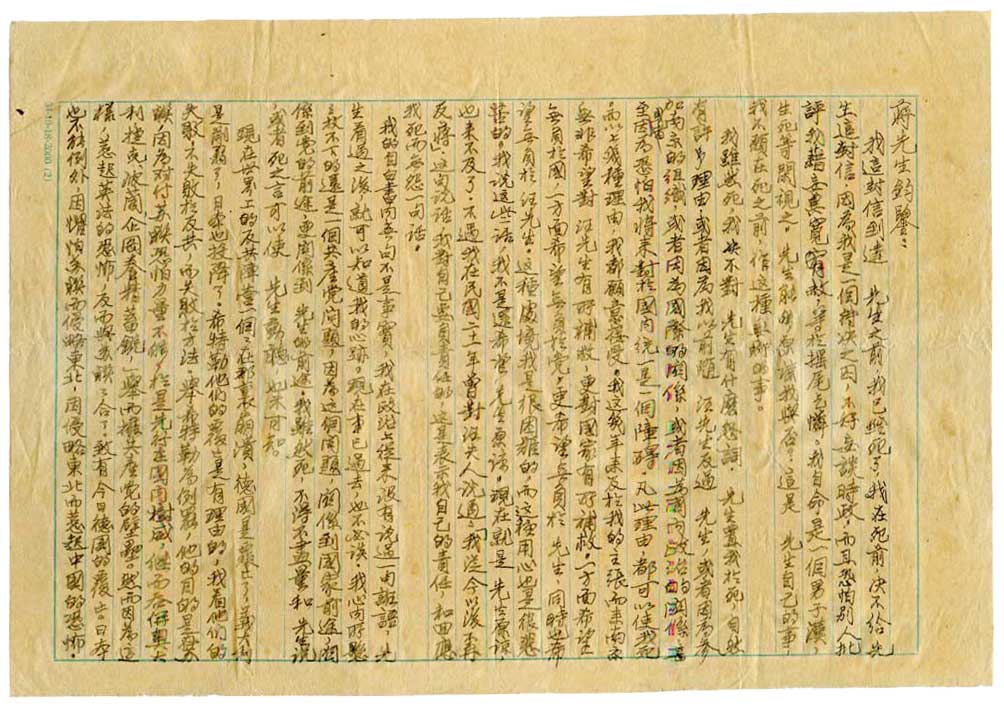
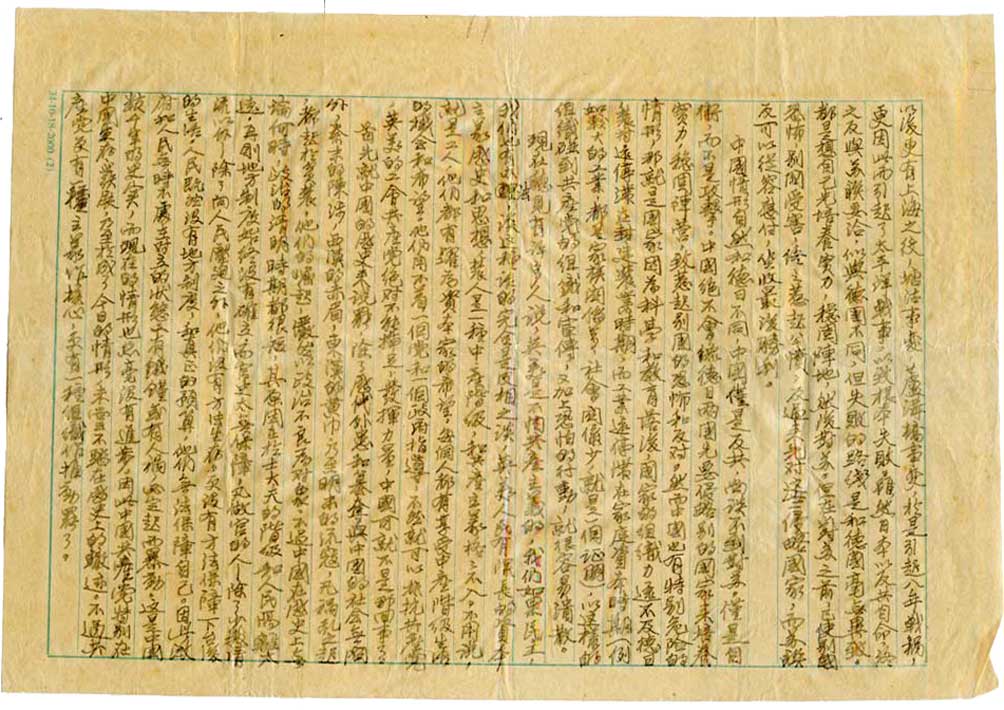
CHEN GONGBO’S UNFINISHED LETTER TO CHIANG KAI-SHEK, HAND-COPIED BY JAIL-MATE
Before he was executed at Suzhou Lion’s Mouth Prison, he wrote a lengthy letter to his family. He also wrote a letter to Chiang Kai-shek, which mentions their political grievances and his wish that Chiang would understand his anti-communist ideas and pay attention to the potential danger the Communist Party poses. In the end, the letter was not finished. Chen stopped with a sigh.
The authorities must have their own way of doing. Whatever I say is useless. It’s better not to say more.
Before the execution, Chen Gongbo gave the teapot that he used regularly to fellow inmate Chen Bijun as a souvenir. He bowed and said to her :
With my leaving, I can finally face Mr. Wang underground.
After hearing this, Chen Bijun was moved to tears.
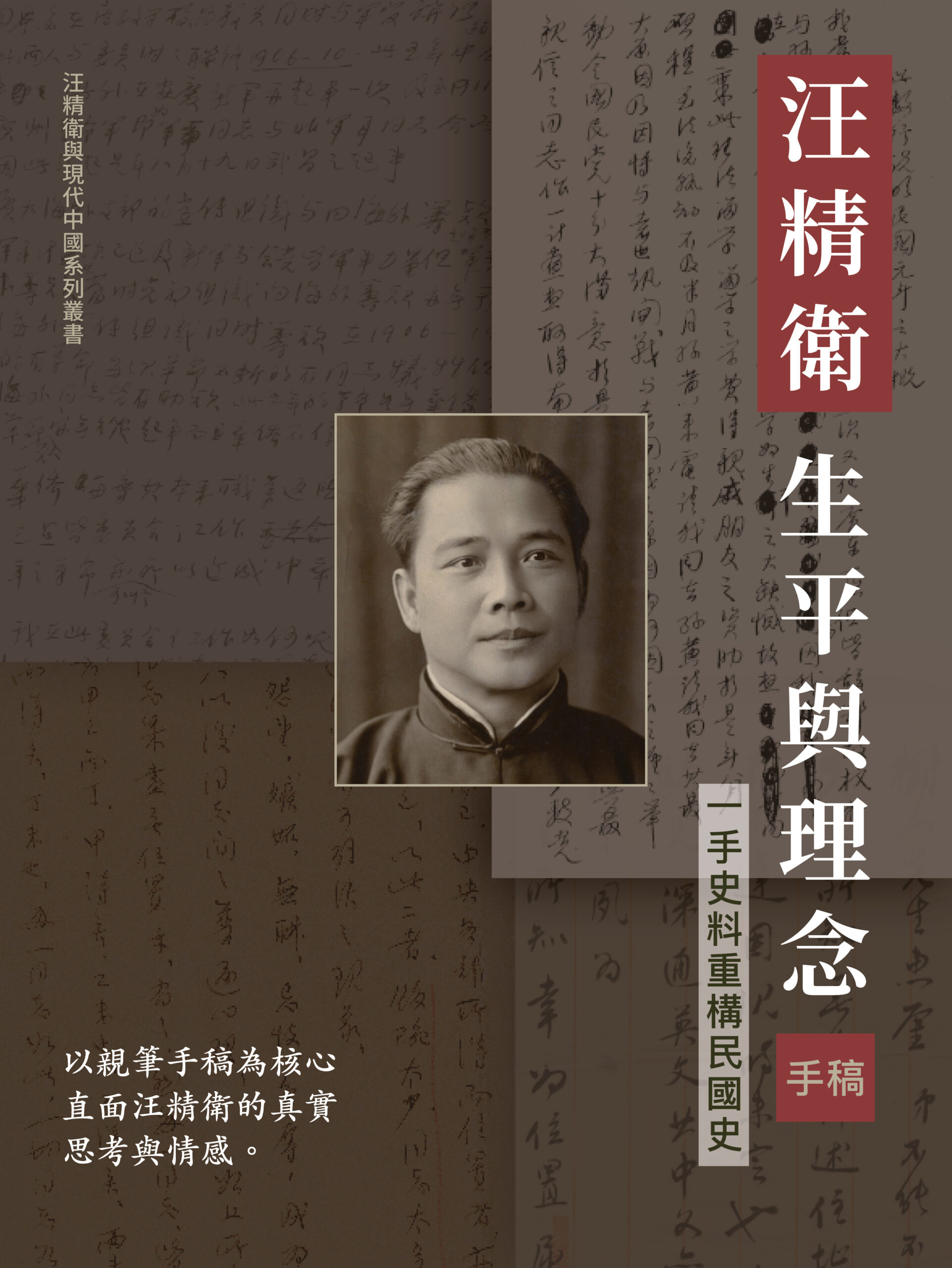
Although Chen Gongbo did not write much poetry, Wang Jingwei thought he was very talented. During his final days at Lion’s Mouth Prison, Chen Gongbo gave his latest poems and unpublished works to his only son Kan and also made a hand-copy for Chen Bijun. In 2013, Kan Chen published Chen’s poems and other writings in Chen Gongbo Shiji (Chen Gongbo’s Poetry.)
References
Chen Gongbo. Kuxiao lu (Bitter Smile). Beijing: Dongfang chubanshe, 2004.
Chen Gongbo. Hanfengji (Bitter Wind), Shanghai shudian, 1989.
Chen Gongbo. Banianlai de huiyi (Memory of the Last Eight Years), Shanghai: Guangfu chubanshe, year unknown.
Jin Xiongbai. Wang Jingwei de kaichang yu shouchang (The Rise and Fall of the Wang Jingwei Regime), 5 Volumes. Hong Kong: Chunqiu chubanshe, 1959-1964.
The Nanjing Municipal Archives, ed. Shenxun Wangwei hanjian bilu (The Trial Transcripts of the Collaborators of the Wang Jingwei Puppet Regime). Nanjing: Jiangsu guji chubanshe, 1992.
Chen Gan ed. Chen Gongbo shiji (The Poetry Collection of Chen Gongbo), 2013.
Chen Gan ed. Chen Gongbo shiji zengdingben (The Poetry Collection of Chen Gongbo, enlarged edition), 2015.
now available as individual e-books and in print